‘The Island of the Blue Dolphins’ by Scott O’Dell Review

The Newberry Medal winner The Island of the Blue Dolphins by Scott O’Dell is an interesting book. It pits the will of a young girl against many dangers in an isolated setting. The struggle for survival in this text captures an intense narrative about making difficult choices at a young age. Sometimes, young-adult fiction can miss the mark with young people’s lives–and sometimes they can be visceral. Throughout The Island of the Blue Dolphins, we see a coming-of-age story about survival and being at ease with your circumstances.

Summary of the Blue Dolphin

The Island of the Blue Dolphins is about Karana (Won-a-pa-lei), a Nicoleno girl who lives alone on an island off the coast of California. Karan lives alone on the island after her people engage in a battle with Russian fur hunters. Karana takes to her new life by adapting to the island without her community while battling feral dogs. The story revolves around her struggles and her reticence to be rescued.

Back of the Book

From the book: “In the Pacific there is an island that looks like a big fish sunning itself in the sea. Around it, blue dolphins swim, otters play, and sea elephants and sea birds abound. Once, Indians also lived on the island. When they left and sailed to the east, they leave a young girl behind. This is the story of Karana, the Indian girl who lived alone for years on the Island of the Blue Dolphins. Year after year, she watched one season pass into another and waited for a ship to take her away. But while she waited, she kept herself alive by building shelter, making weapons, finding food, and fighting her enemies, the wild dogs. It is not only an unusual adventure of survival, but also a tale of natural beauty and personal discovery.”

Critical Response

Most critics and reviewers praise the novel. It is a Newberry Medal-Winning classic, along with a Hans Christian Andersen Medal. On Goodreads, the novel has 108,363 five-star reviews. Reviewers write that its lessons in survival and readability are beneficial. One reviewer wrote: “Karana’s remarkable story is not to be missed. A story that is enjoyable for adults as it is for older children!”

However, the book also has 10,168 one-star reviews, with reviewers stating that the book relies on stereotypes of Indigenous Americans. Additionally, reviewers have pointed out the “two-dimensional” characters. They also stated that the reader should see far more growth in the main character over 18 years.

Impressions

Negative reviews aside, I had a recent thought about The Catcher in the Rye as a book that I still can not really get behind, even though I read it precisely when I should have read it as a young person. I may be a phony, but I can see how the appeal of this book has waned in the new era of social understanding.

The development of this character over the course of the novel is an important plot construct to note. She seems to be a living, breathing character who is quiet industrious and capable of success. As a coming-of-age story, it shows the reader how somebody from a different background and different view of life and change into somebody capable of surviving on their own. The Island of the Blue Dolphins creates understanding. That is really important for a book.

On the blog, I have looked at a few novels about survival that stand as great testaments to children’s literature. These novels include Hatchet and a few others. I think I will give this book a reread at some point to just take in the multimodal accompaniment that this novel has created, from movies to critical responses in print.

Greek Mythology Origins, Chaos, and Gaea

Where does one start with the origins of Greek Mythology? After all, it can be difficult to understand the difference between myths, legends, and tall tales. Perhaps at the creation of everything is the only place to start. Greek mythology really begins with Gaea and move ahead from there in a linear fashion, a little at a time.

A Prelude to Mythology Origins

If you are new to Greek mythology, all you have to know is a couple of things:

  1. Myths are used to help explain the world. They answer the why question using fantastical elements (magical weapons, monsters, and heroes);
  2. Personification is when we give human characteristics to nonhuman subjects;
  3. Before the start of the world, there was only emptiness and Chaos.

Putting the World Together in Darkness

According to Greek Myth, in the beginning of the world, the vacant void of space existed everywhere. Chaos personified, made of void, mass, and darkness, reigned in this vacuum.

Though, sooner or later, the void began to fill as Gaea emerged from this nothingness. She appeared on her own, created by Chaos, along with her two siblings. Those siblings are Tartarus and Eros, who were the deities of the Underworld and Love, respectively.

More gods were to follow (created by Chaos), including Erebus (Darkness) and Nyx (Night), who together created Aether (Light) and Hemera (Day). Nyx, too, created a family on her own, including: Moros (Fate), the black Ker (Doom), Thanatos (Death), Hypnos (Sleep), Oneiroi (Dreams), Geras (Old Age), Oizus (Pain), Nemesis (Revenge), Eris (Strife), Apate (Deceit), Philotes (Sexual Pleasure), Momos (Blame), and the Hesperides (the Daughters of the Evening).

All the same, Gaea in Greek myth is an important deity. She was “described as the giver of dreams and the nourisher of plants and young children.” In time, she created the universe and Earth as we know it, giving names and gods to the things that shape our world, such as Uranus (the sky), Ourea (the mountains), and Pontus (the sea).

Everything in Greek mythology needed some kind of name or characteristic so that it fit within a narrative. For example, the mountains are not just rocks, but a character named Ourea. They are the child of the primordial progeny of Gaea. Now, being personified, we as listeners or storytellers can learn something about the world, and, more specifically, about the mountains.

On Greek Mythology and Personification

It is important to note, and as mentioned, that Greek Myth focuses on personifying elements and objects to give life to their stories. After all, the Earth is quite a character, and tying that into something like the creation myths of a culture is important work. Gaea can get into trouble, or it can be a seething tempest that is up to hear with its husband. By creating these personified character, the Greeks were able to not only share wonderful stories, but they could also explain their world. Gaea, though factoring heavily into a creation story, gives life and purpose to the Greek people.

Conclusion

Gods take on many different forms in the origins of Greek mythology. They can either be humans or simply forms with names ascribed to them. This is an important fact to understand. For the Greeks, all things in the world needed some kind of personification to answer that why question.

Psycho by Robert Bloch: Understanding Inspiration

Author Robert Bloch was an important writer in the history of the horror genre. He is also somebody who contributed a great deal to multiple formats of writing—short stories, screenplays, etc. Psycho (1959) by Robert Bloch, is a mainstay of the horror genre and has spawned multiple movies and television shows.  By examining this landmark novel and its source of inspiration, writers can see the true nature of inspiration.

‘Psycho’ by Robert Bloch Summary

Psycho details the story of Norman Bates, who is a caretaker at an off-the-beaten-path motel in Fairvale. His mother dominates his life, who refuses to let the young man out of her peremptory grip. They argue about the failing motel, whose business has been recently rundown by the relocation of a nearby highway. 

After his mother murders Mary, a woman who is on the run for stealing cash from her real estate client, Norman disposes of the body. Afterward, he continues caring for the motel…and its aging matron. After the woman’s sister, Lila, Marion’s ex-boyfriend, Sam, and a private investigator, Arbogast, come looking for the now deceased woman, Norman’s mother strikes again. This time, she kills Arbogast with a razor while the former two are out investigating. 

After further inquiry by Lila and Sam, some revelations occur. First, Norman’s mother has been dead for years, and Norman spent time in a mental institution. Second, Lila finds the corpse of Ms. Bates in the fruit cellar, Norman attacks her. Horrifyingly, he is is wearing his mother’s clothes. Luckily, Sam stops Norman. The explanation given is that Norman turned into his mother after a bout of matricide in which he poisoned her and her lover out of jealous rage. Confined to a mental institution for life, Norman psychologically transforms into his mother. There, he deigns to prove that he wouldn’t dare even hurt a fly. 

How Inspiration Informs Our Novels

The Gein Inspiration

Inspiration can be a tricky thing to conjure. You may have to be in the exact right mood. Or, maybe you have to be lying in bed in the morning, or maybe you have to be taking a shower…or perhaps you are just out mowing your lawn. Regardless, inspiration will come smack you right in the head with a great idea. 

Whatever it is that works for you, works for you. 

The story of Ed Gein inspired the story behind Psycho (1959) by Robert Bloch. Gein also has a relationship with multiple personality disorder and murder. For instance, he had murdered two women and set himself about crafting a skin suit after his own mother’s heart. In this case, inspiration came from real-life scenarios. Additionally, it comes with some past stories of Bloch’s earlier works that also dealt with multiple personalities and grim situations.

As written by Galaxy Press: “In this regard, Robert Bloch’s protagonist, Norman Bates, was much like Gein. Bloch realized, ‘I’d discovered how closely the imaginary character I’d created resembled the real Ed Gein both in overt act and apparent motivation’.”

Bloch wrote Psycho over a six-year span in Weyauwega, Wisconsin. As Bloch later stated, he based Psycho on a “situation rather than any person, living or dead…” 

As Shane Nyman writes in an article for Post Crescent: “Living only about a 35-minute drive from Plainfield, the already-accomplished Bloch read about the discoveries at the Gein family farm when it hit the papers in 1957. Two years later, the world was introduced to Norman Bates.”

Bloch’s Version of the Story

And, yet, Bloch also disputes the claims of his immediate knowledge of the incident. He wrote in his 1993 memoir that he knew “very little” of Gein at the time of his writing, only realizing the connection years later when writing an essay about Gein. He soon realized that there were lots of similarities between his novel and the case. 

I think, in this way, inspiration was a sort of parallel thinking in the ether. It was the right time and place for the story to happen, and so was the Gein case. It’s horrible to think, but lots of murders occur and books are written at the same time. Some of them build traction with the public and some don’t build traction at all. It’s an Overton Window of sorts where whatever is happening in the zeitgeist propels a story to success. Yet, two sources of inspiration can happen in tandem. 

Conclusion

Regardless of how you are inspired—whether by true crime events now or later—inspiration can bring forth interests that we already have and allow them to proliferate on the page. Bloch loved true crime, such as Jack the Ripper and Lizzie Borden, so it makes sense that inspiration came to Robert Bloch for Psycho in the form of his interests. 

He was also devoted to strange fiction and tales of the macabre, which even featured his mentor’s death:

The Library of America states that: “One of the stories Bloch wrote while (H.P.) Lovecraft was alive featured Lovecraft as a character, killed by a monster. Weird Tales required Bloch to get the victim’s permission before publishing the story, and Lovecraft authorized Bloch ‘to portray, murder, annihilate, disintegrate, transfigure, metamorphose, or otherwise manhandle the undersigned in the tale entitled THE SHAMBLER FROM THE STARS’.”

In so many words, find your inspiration where your love is at, whether that be stories like Psycho by Robert Bloch about killers in the Midwest, or stories where you yourself are doing the killing.  

The Profound Connection of Love and Poetry

There’s a million poems and poets out there. Additionally, there are an infinite number of themes. In this way, poetry and love are forever intertwined. Love is hard to describe, and poetry always finds the words–maybe it’s the exceptional person wielding the pen who makes it look so easy and not the form after all. Yet the question remains as to why poetry seems to be in league with love. There are a couple of poets whose unique looks create an understanding between the two topics: Carl Sandburg, and Emily Bronte.

Viewing the world through Sandburg and Bronte

Poetry and love with Carl Sandburg

Poetry can invoke a very romantic language, as poetry fits so perfectly for pining after somebody. Additionally, just observing the folly of love or the “give and take” of romance can so perfectly obfuscate meaning in an interesting way. Take for instance, Carl Sandburg‘s poem “Offering and Rebuffing,” which so delicately plays with love and feelings toward love.

Sandburg writes: “I could love you/as dry roots love rain,” Sandburg writes. “I could hold you/as branches in the wind/brandish petals./Forgive me for speaking so soon … Love is a fool star” (Sandburg). There’s some cynicism there, which is probably warranted when it comes to love. Cynicism and love are also a perfect pair for the lovelorn. Though, not all poems are so cynical and many actually give us keen insight into how relationships operate on some level.

Poetry and love with Emily Bronte

For instance, Emily Bronte’s “Love and Friendship” invokes the duality of marriage and love when we get our most sour. “Love is like the wild rose-briar,/Friendship like the holly-tree–/The holly is dark when the rose-briar blooms/But which will bloom most constantly?” Bronte’s poem reminds the reader that marriage is a partnership between two friends even if love can seemingly fizzle out sometimes. Only through poetry can we really see this complexity of love in a different way.

Conclusion

Readers must thank the elucidating powers of poetry because poems have a way of conveying the most difficult feelings. Love is certainly one of those difficult feelings, but poetry adeptly explains the mystery of sparks igniting in our brains. So, whether the holly is dark or the roots dry, sometimes it’s just nice to have an explanation to the most complicated things in life … if only to make our feelings just a bit more clear.

How to Correct Verb Shifts and Save Your Writing

When writers correct verb shifts, it can be a difficult grammar skill to master. Essentially, verb tense asks writers to be aware of their sentences in complex ways, from the mundane story to the action scene. Likewise, you have to ask yourself a few questions: Are you writing in the present tense or past tense? And if you are unsure, how can you be sure?

Using Past Tense in Stories

Typically, a written narrative is written in the past tense because you are telling a story that has happened in the past. As such, you should focus on your past tense verbs in writing.

For example:

“I went to the park yesterday and saw some of my friends playing a game. They let me join, but they said I had to be the scorer. I hated being the scorer.”

In this example, we can look at words like “went,” “saw,” “said,” and “hated” as indications of tense. The narrator had “gone” to the park, and they “hated” being the scorer. It’s important to keep this tense consistent so we don’t confuse the reader.

Additional examples:

Incorrect: I opens my Christmas gift and cries because of its beauty.

Correct: I opened my Christmas gift and cried because of its beauty.

Using the Present Tense for Essays

The following rule is one I mess up all the time, because it seems wholly unnatural. However, it makes sense as it relates to writers who correct verb shifts once you read it.

“In The Wonderful Wizard of Oz, Dorothy meets the Tin Man and he joins her on her adventure. The Cowardly Lion soon joins them and they head off to the Emerald City together.”

While we might assume that the action of the novel has taken place, it is the present experience that we are writing about, as if we ourselves are telling the story. Therefore, we are in the moment of the telling.

Incorrect: In Chapter 3 of A Connecticut Yankee in King Arthur’s Court by Mark Twain, Hank Morgan looked at the knights as they came over the hill and swallowed his pride.

Correct: In Chapter 3 of A Connecticut Yankee in King Arthur’s Court by Mark Twain, Hank Morgan sees knights riding over the hill and this makes him swallow his pride.

Conclusion

Knowing what tense your story or essay is in will keep you consistent. Write the tense down in the margin if you must or in your text’s footnotes; that way, when exploring options in revision, you know what resources to seek out. As well, please keep in mind that tenses are tricky and when to use the correct one might be a matter of consulting a handbook or a reliable grammar website. Focusing on these issues often as a mode of editing will keep your skills sharp and your tense in tact.

Remember: providing clear explanations and descriptions is ideal and using correct verb tense can help you sound like you are a professional in your field.

Greek Myth: Uranus, a Monster Who Created Monsters

As mentioned in a previous post, Greek mythology is a complicated web of characters birthed by multiple deities. The birth of Uranus (son of Gaea) in Greek Myth also has his own part in creating monsters, both figuratively and literally. In examining his birth and rise to power, we can see how he created the more modern understanding of warring gods who fight for control of mortal fate and destiny.

The Creation of a Greek Myth Tyrant

In Greek Myth, Uranus (also known as Ouranos) was born from Gaea. The lady of Earth grew lonely and wanted company and birthed him on her own. Afterward, Uranus ruled the sky (or the Heavens), and his siblings ruled the mountains (Ourea) and the sea (Pontus). Uranus successfully wielded this domain expertly, too, as it was from Uranus’s lungs that we have the air with breathe. He contributed monumentally to the construction of Earth’s livable habitat. Thus, it stands to reasons that Uranus was the all powerful deity of Earth, and its first ruler.

It was not long before Uranus slept with Gaea and began to make children–of which they had many. These included the three Cyclopes, six daughters (Theia, Rhea, Themis, Mnemosyne, Phoebe, and Tethys), and six sons (Oceanus, Coeus, Cius, Hyperion, Iapetus, and Cronus). The latter two-thirds would make up the Titans (Britannica). Moreover, and for future reference, having copious amounts of children was a through line for Greek mythology.

Overthrowing the Primordial God

Now remember, we have personified characters here, so both Uranus and Gaea are the Heavens and the Earth and they are making children. However, Uranus didn’t want children for one reason or another so he stashed them away inside of Gaea’s (or Earth’s) body. Uranus’s actions made Gaea bitter, and so she plotted to repeal her husband’s actions by convincing her children to revolt against him. However, all of her children were afraid of Uranus’s power; well, all except for one–Cronus.

After crafting an adamite scythe (or a scimitar in some stories), Gaea gave it to Cronus and told him to hide in wait for his father who would come to lay with her. And, indeed, Uranus was a randy god and came to lay with Gaea. At this point, Cronus emerged from his hiding place in his mother’s womb, and he used the scythe to castrate his father.

Remember, too, as with all stories, Greek mythology has been told differently through the years. For example, another retelling features more than just Cronus getting involved with castrating Uranus, and the details are as follows:

“Four of these (sons) positioned themselves at the corners of the world, ready to grasp their father as he descended to lie with Earth, while the fifth, Kronos (Cronus), took his place in the centre and there castrated Ouranos with an adamantine sickle.”

Uranus, meanwhile, either died or fled, but not before the spurt of blood from his wound further impregnated Gaea with the “avenging” Furies, the Giants, and the Meliai; and, “avenging” is right because Uranus’s overthrow creates the beginnings of war that would continue through much of Greek mythology.

Conclusion

Uranus wasn’t a good guy, but he did do a lot to create the world. Though, we can see in our story about Uranus that there is a lot to learn about the world and about ourselves.

Number one, we have a lesson on the creation of our planet and how the air we breathe and the Heavens above came into creation. Number two, we have a lesson about taking care of your children lest you create bitter hatred in your family, which might also be a lesson about caring for those around you.

Lastly, and as we will see in future posts, Uranus’s actions bleed into other characteristics found in his children (Cronus for sure), and the Furies, and the Cyclopes.

Examining Gary Paulsen’s ‘Dogsong’: Nature and Survival

Gary Paulsen was an incredible author who wrote a delightful body of work. His novels have inspired many young adults to write their own stories of nature and survival. His 1985 novel Dogsong, which is another popular novel by Paulsen, carries this familiar theme. It has had an incredible impact on young adults and the world of young-adult fiction. 

Summary of the Novel

Dogsong tells the tale of 14-year-old Russel Susskit. Susskit falls out of love with modern society and government homes. So, he decides to leave his Inuit village in search of a “song” for himself, just as his ancestors once did. Modern “necessities” plague his village and have driven into his family’s culture by outside missionaries, including Christianity and smoking.

Before leaving, Russel speaks with Oogruk, an Inuit elder, who still clings to the old Inuit ways of living. The old man tells Russel of old Inuit traditions. These traditions include the search for individual songs that disappeared from the culture due to the missionaries. After a time, Russel is told to go North until he finds his own song. It is through his travels with Oorgruk’s sled dogs, that Russel finds his calling in life in the world.

Toward the end of Russel’s journey, he is confronted with a near-death, frozen pregnant woman, Nancy, who needs help during a vicious snowstorm. He helps her and finds her cover in an abandoned shack; after nursing her back to health, he eventually hunts a polar bear for food. When the woman gives birth, the child is stillborn, which profoundly effects Russel. Seeking medical attention, he takes Nancy to a village on the coast and ends his journey, having bonded with his sled dogs and finding a deeper, more traditional purpose. 

Background of Dogsong

Dogsong was written while Gary Paulsen was preparing for his first Iditarod and was published in 1985. Pauslen said that the story came to him during that 1983 Iditarod.

“It was – an Eskimo boy asked me to teach him about dogs,” he said in an NPR interview with Terry Gross. “And I thought then of a book about an Eskimo boy using a dog team to find his heritage. And I wrote the book, and then it won a Newbery honor … that kind of – everything took off then.”

Paulsen published the novel in 1986 and he received the Newbery Honor in 1986.

Analyzing Dogsong

Survival

Reviewers have defined Paulsen’s work by the harsh nature of the wilds and of hardships. Hatchet, for instance, is an unflinching look at survival, cause and effect, and problem and solution. Dogsong is much of the same. On his father’s smoking and coughing, the protagonist thinks: “The sound tore at Russel more than at his father. It meant something that did not belong on the coast of the sea in a small Eskimo village. The coughing came from Outside, came from the tobacco which came from Outside and Russell hated it” (Paulsen).

Russel’s musings on his hatred of his everyday life stems from the cause of missionaries and the effect it has had on his community. Religion hangs on his walls (literally), and his own father turns to a god that Russel doesn’t understand. In other words, Russel has a problem with how the world lives around him and the solution eludes him, because the traditional ways are no longer in existence, replaced by false theism.

Theism

Later, after Russel has moved in with Oogruk, he searches for meaning—an answer to his problem. In addition to his problems with the world he lives in as a child, he is also a poor hunter, so he studies to hunt small game even while other problems lay ahead. “So he made meat. Light meat. That’s what Oogruk called it. And it was good meat, as far as it went. The small birds tasted sweet and were tender and soft…But the dogs needed heavy meat, heavy red meat and fat or they could not work…” (Paulsen).

Russel loves the idea—the romanticized idea—of his Inuit tradition, but finds that the practical nature of the old way of life is challenging. His stoicism drives him forward in the face of ugliness and danger. He stands in the face of new religion for the old ways.

Nature

Nevertheless, Russel truly finds the beauty of nature and of the hunt later when he travels north. He soon learns that the beauty of the land comes from its danger. Oogruk, dead of old age, prompts Russel to find his “song” in the frozen lands where his people used to thrive. “It was hard to believe the beauty of that torn and forlorn place. The small mountains—large hills, really—were sculpted by the wind in shapes of rounded softness, and the light …” The contrast of danger and beauty is effective in this story. It illuminates the reality of nature: it is wholesome to look at and wonder. Yet, it is utterly dangerous for the uninitiated (see To Build a Fire).

Meanwhile, the dreams Russel stomachs during his journey mirrors his frustrations and struggles and gives him some insight into his own problems. These dreams revolve around the struggles of nature and mirror Russel’s own journey, providing him with solutions and ways to live and thrive with his new traditions.

Tradition

We can learn a lot from this book, and not necessarily in solely the rejection of modern amenities; but it doesn’t hurt to look at it that way. Our rejection of the niceties of the modern world may in fact allow us a deeper relationship with ourselves and our past traditions. As an urban contrast, My Dinner with Andre (1981) deals with a similar idea.

Consider this: Russel does not have to deal with the traumas associated with social media and our algorithm-based society, which is less reliant on tradition and reflection and more consumed with selfish pursuits of personal idolatry. His father’s pursuit of a new religion for answers throws aside the historical importance of the Inuit society—the way they used to live—in pursuit of this new way. However, it stands in contrast to what the community needs to survive. Sure, Russel’s village hunts seals, but they do not engage with nature as they once did, as their ancestors once did, to survive.

Conclusion

When the missionaries and the new religion leave, what are they left with? In this question, we can understand Russel’s need for his culture and the culture of his ancestors. Russel’s rejection of this modernity allows him to touch base with his history and with his soul. In the closing poem of Dogsong, Paulsen, or Russel, tells us, “Come, see my dogs. / With them I ran, ran north to the sea. / I stand by the sea and I sing. / I sing of my hunts / and of Oogruk” (Paulsen).

A River Runs Through It and the Stories They Tell

“Eventually, all things merge into one, and a river runs through it,” writes Norman Maclean in A River Runs through it and Other Stories. “The river was cut by the world’s great flood and runs over rocks from the basement of time. On some of the rocks are timeless raindrops. Under the rocks are the words, and some of the words are theirs. I am haunted by waters.”

I like taking walks in the city I live, and I also like taking photos of the river that runs near my house. The river is an interesting place to watch, because of the birds and the other animals, but there is also a lot going on there depending on the time of year. A lot of boats in the summer. Shanties in the winter. Leaves on the breaks in the fall.

There are stories there.

The Waters and Their Stories

Whether the waters are haunting or not doesn’t matter too much to me, because there lots of other stories to tell. Most of them don’t involve the early death of one’s sibling or the fear of drowning when rafting the rough currents. Similarly, the stories get me thinking and that’s a good way to spend an evening or a morning. It’s especially true if you are trying to make sense of one that’s tricky.  

In Robert Louis Stevenson’s poem “Looking-Glass River” he states: “Smooth it glides upon its travel / Here a wimple, there a gleam– / O the clean gravel! / O the smooth stream!”

What this means is, I can’t speak for the clean gravel in my neck of the woods, but I believe I’ve seen a wimple and gleam here and there as I follow the shore on either side. Often, I’m silently confronted by early risers out for their morning strolls or nightwalkers seeking the evening calm.

“I do not know much about gods; but I think that the river / Is a strong brown god—sullen, untamed and intractable,” wrote T.S. Eliot in The Four Quartets. “The river is within us, the sea is all about us; / The sea is the land’s edge also, the granite / Into which it reaches, the beaches where it tosses.”

Spirituality and the Waters

The divinity placed upon water itself is apparent in much religious writing. It is a cathartic and purifying method of being born anew. Water has been of critical importance to both maritime law and commerce for ages, importing and exporting food and famine, war and peace. It has also been a source of wonder and musings about existence.

In “The River,” Ralph Waldo Emerson penned:

And I behold once more

My old familiar haunts; here the blue river,

The same blue wonder that my infant eye

Admired, sage doubting whence the traveller came,—

Whence brought his sunny bubbles ere he washed

The fragrant flag-roots in my father’s fields,

And where thereafter in the world he went.”

The words Emerson chooses, including “Admired” and “sage” dignify the waters in a way that create a spiritual understanding. Additionally, blue wonder and blue river speak to the calming feeling that water imparts to humanity. According to Emerson, the waters are something to truly behold.

Conclusion

Mostly, we don’t know where the river’s been or where it goes, because we can look at it and think about the images it conjures in our animal brains; but, mostly, walking by the water gives me piece of mind. Yet, there are many things to see and there are many things to think about.

I am about both sometimes.

Crafting Atmosphere in Writing for Better Stories

Atmosphere is an essential part of reading and writing. It is a catalyst for all of the feelings that a reader will experience throughout a book or story. There are not many books that are devoid of atmosphere, and if there are–they are probably experimental in nature. Atmosphere is hard to avoid in writing. It can be a subconscious effort from a writer describing their life or the fictitious lives of their characters. In this post, we are going to discuss the idea of establishing “atmosphere” in stories.

Defining Atmosphere in Stories

In defining atmosphere, Merriam-Webster states that “atmosphere” is a “surrounding influence or environment.” It is also, “the overall aesthetic effect of a work of art.” Additionally, it is stated that “atmosphere” is “an intriguing or singular tone, effect, or appeal” in a piece of writing. In combining these ideas, we can see that atmosphere is like the coat a story wears to give off some impression. Gloomy coats give off gloomy vibes, while sunny coats give off sunny vibes.

Another way to view “atmosphere” is through the mood an author establishes in a story. Mood, in this instance, refers to how the reader feels when they are reading a story. For example, when reading a horror story, you might feel scared, anxious, or apprehensive about what is to come next. The mood, however, differs from atmosphere, as mood is an overall feel of the writing in the moment, as opposed to atmosphere, which is the aesthetic, or the feel of the writing from cover to cover.

Specifically, these two words are interested in describing two bits of minutia in writing: the micro-feeling of words (angry and worried), and the macro-feeling of words (creepy or strange).

Identifying Atmosphere in Fiction

In looking for examples of atmosphere, it can either be difficult or extremely apparent. For instance, in The Halloween Tree by Ray Bradbury, we have a “nostalgic” atmosphere that appeals to Bradbury’s youth and memories of Halloween night. The story tells the tale of a group of boys who ventures with a mysterious man named Moonshroud on Halloween night to save their friend pip. The story uses an overtly “sensory-driven” atmosphere, as Bradbury’s poetic style fixes on the reader’s senses to overdrive the narrative in imagery.

Here’s an excerpt:

Eight boys made a series of beautiful leaps over flowerpots, rails, dead ferns, bushes, landing on their own dry-starched front lawns. Galloping, rushing, they seized a final sheet, adjusted a last mask, tugged at strange mushroom caps or wigs, shouting at the way the wind took them along, helped their running; glad of the wind, or cursing boy curses as masks fell off or hung sidewise or stuffed up their noses with a muslin smell like a dogs hot breath. Or just letting the sheer exhilaration of being alive and out on this night pull their lungs and shape their throats into a yell and a yell and a … yeeeellll!

The Halloween Tree | Ray Bradbury

In examining this excerpt for atmosphere, let’s dial into the “nostalgic” part of it, as Bradbury takes us through the motions of boys hooting through the spookiest night of the year. If we use our previous simile in that atmosphere is like a coat on a story, then we are looking at a sentimental view of boyhood.

Bradbury states that there is a frantic sort of energy amongst the boys. The energy is both frantic and exciting. It is happy. Who doesn’t have this memory of Halloween? The feeling is there but at a much larger level than say, “happy” or “joyous,” which is more definitive of mood.

Additionally, the “sensory” portion of our atmospheric analysis can be pulled from the same excerpt. For example, “dead ferns” references our visual senses, because we can see that in our mind’s eye. Bradbury finishes the description with “letting the sheer exhilaration of being alive and out on this night pull their lungs and shape their throats into a yell and a yell and a … yeeeellll!”

Our auditory senses are pulled toward the enthusiastic scream of the boys. Enthusiasm, in this case, being descriptive of mood, while the sensory feeling of description is the overall atmosphere. Bradbury’s The Halloween Tree is replete with sensory descriptions, and these descriptions build the atmosphere.

Tips for Writing Atmosphere

One tip in tracking atmosphere or even implementing it in your own writing, is to treat atmosphere as a post-writing/reading consideration. What did the book feel like across the whole body of the work? What feelings did you experience the most, and what word comes to mind that describes all of those emotions?

After you have answered these questions, you can begin going back through the text and sprinkling in your atmosphere. In this way, you need to identify the atmosphere itself. If you are writing a noir mystery, you might want to add more smoky rooms and shadows. If it’s a romance story, adding more fluffy language may better mold your story to the genre.

Conclusion

There are many techniques in writing, so deciding which ones to employ is essential. Atmosphere may seem like a small detail–but it is a major element. The atmosphere of a text describes the larger picture of a work of narrative. It steers us in a larger direction rather than touching on our lesser feelings, such as horror, happiness, and anger. The atmosphere of a novel can sometimes be difficult to track, as a reader has to take the whole of the text into consideration rather than just a few examples here and there.

“November” by Sara Teasdale Analysis

In November, the frost wakes us up in the morning, and we can smell the winter on its way. Yet, autumn is still there in the ground. The leaves, red and gold, lay covered in what will soon be snow. November may be a strange moth of transition, but many authors have tried to capture its wonder. With that said, Sara Teasdale’s poem, “November” perfectly encapsulates the month and captures the spirit rightly. This “November” by Sara Teasdale analysis discusses Novembers cold and kindness.

Summary

In this poem, Teasdale comforts a lost love by comparing it to the dying year. She tells us in the first two lines. She writes: “The world is tired, the year is old, / The fading leaves are glad to die.” The use of “tired” and “glad” here do not necessarily ring menacing, but rather undercuts the overall theme of comfort. That is to say, the season is happy to move on.

However, with transition in life comes the harsh reality that moving ahead can be painful. She writes in the final two lines of stanza one: “The wind goes shivering with cold / Where the brown reeds are dry.” This is evocative, as in “shivering with cold” we can see the season itself rubbing its arms together for warmth.

Toward the end of the second stanza, Teasdale reveals the truer nature of the poem. She states that, “Our love is dying like the grass, / And we who kissed grow coldly kind, / Half glad to see our old love pass / Like leaves along the wind.” That is to say, the love that has passed between two people, like seasons, can pass into coldness. Yet, inside of that love is a dormant kindness. It is a love that has distance but there is remembrance. Moreover, the ones we “kissed grow coldly kind” implies something deeper. Love is gone, but kindness remains in a state of “half glad” remembrance.

Conclusion

Teasdale poem gives us a good sense that autumn is alive in November, but it’s on its way out. Meanwhile, the weather, though cold and growing colder, has a memory of kindness and more autumnal days. In the end, Teasdale links November to love and cold kisses. She grants the reader a sense that love of the summer/fall is gone, but that people have a reverence for its passing. This “November” by Sara Teasdale analysis explains how November guides us to winter. Yet, its lasting imprint fuels our love and creativity.

Why Writing Simply for Clearer Meaning is Important

Often, beginning writers write long, winding sentences that lose track of their meaning. Typically, this happens because novice writers have a lot to prove, and simply do too much. What budding writers forget is that writing simply for clearer meaning is important. Writing simply is an important function of writing because it shows that the writer has a direct command of language. In this way, they are able to say more with less. It is okay to write big, long sentences with lots of punctuation and conjunctions from time to time. Yet, it is an entirely other thing to write simple, direct sentences that pack a lot of meaning.

How Can Writers Write Simply for Clearer Meaning

To start, a simple sentence has a subject and a predicate, and this also makes it an independent clause. Both terms are interchangeable: simple sentence = independent clause.

A sentence is independent because it can stand on its own. So that also implies that a simple sentence should start with a subject and end with that subject doing something. After all, a simple sentence is a subject and a predicate. Therefore, simple sentences are very direct.

Henry played his guitar loudly. The flurry of music filled his head and he smiled.

The above sentences are simple but tell a great deal. We learn about Henry, that he is a musician, and that he loves music. He is probably very good at playing guitar, too, because the writer used the words “flurry” and his appreciation of this is apparent. In this instance, simple sentences help writers write clearly, stay on track, and convey meaning.

Let’s look at an excellent example of writing simply from Ernest Hemingway’s In Our Time:

“They shot the six cabinet ministers at half-past six in the morning against the wall of a hospital. There were pools of water in the courtyard. There were wet dead leaves on the paving of the courtyard. It rained hard. All the shutters of the hospital were nailed shut. One of the ministers was sick with typhoid. Two soldiers carried him downstairs and out into the rain. They tried to hold him up against the wall but he sat down in a puddle of water. The other five stood very quietly against the wall. Finally the officer told the soldiers it was no good trying to make him stand up. When they fired the first volley he was sitting down in the water with his head on his knees.”

I believe this passage is perfectly simple, and it tells the audience exactly what the need to know. Of course, if you were a writer who focuses on more flowery passages, this excerpt could be made into something more purple. Hemingway wrote in a very straightforward manner (perhaps too straightforward according to some). So, here is a reedit connecting some of the simplicity while still maintaining its thrust and meaning:

“They shot the six cabinet ministers at half-past six in the morning against the wall of a hospital. There were pools of water in the courtyard, and there were wet dead leaves on the pavement. It rained hard. All the shutters of the hospital were nailed closed, and one of the ministers was sick with typhoid. Two soldiers carried him downstairs and out into the rain. They tried to hold him up against the wall, but he sat down in a puddle of water. The other five stood very quietly, and, finally, the officer told the soldiers it was no good trying to make him stand up. When they fired the first volley he was sitting down in the water with his head on his knees.”

Both passages are simple enough. One is very Hemingway, while the other connects the ideas and avoids repetition. The first is the author’s voice, while the second is creating greater flow between ideas. Both work, and both are simple in construction. They both convey the same meaning.

Verbosity and Grandiloquence

There are writers that use long, complicated words to create mood and to set the tone of writing, and that is totally fine. Those writers are conveying different moods and tones through their use of syntax. However, those writers (Joyce Carol Oats, Flannery O’Connor, Charles Dickens, etc.) have had a great deal of experience writing. And, practically speaking, as a budding writer, the focus on simplicity should be paramount. In other words, writing simply for clearer meaning should be crucial for a beginning writer.

One thing a writer learns eventually is that a thesaurus is not necessary to be a good writer; though, they do come in handy. Yet, one’s eye is much more clear than the ocular device on one’s head, if that makes sense. Thus, grandiloquence is also not necessary for a writer to make a clear statement. Similarly, a large amount of words for wordiness’ sake is just wasting somebody’s time. Oscar Wilde’s The Picture of Dorian Grey is a great example of this verbose idea. Wilde loved words and using lots of different, complicated, ones to convey meaning.

Conclusion

What needs to be said is this: a beginning writer needs to cut down the length of their sentences and their word count in order to discover what is essential. In this way, the writer can see the simple message of their story or essay. Writing simply for clearer meaning allows the writer the freedom to evolve. From a simple passage, they can continue honing the story itself or begin to add more flowery passages while connecting ideas with more creativity and clarity.

An Analysis of “The Selfish Giant” by Oscar Wilde: Magical Allegory

Magic is a wonderful element in fiction. It appears from wizards’ hands and from the Emerald City itself. There are also a great deal of regrettable actions in fiction, that lead characters to sin and vice. Yet, sometimes magic appears in tales of woe and regret. In “The Selfish Giant,” by Oscar Wilde, a magical garden takes center stage, as well as religious allegory and sorrow.

Summary of “The Selfish Giant”

The Angry Giant

Wilde’s “The Selfish Giant” tells the story of a giant who runs a beautiful garden. The beauty of this garden is truly magical indeed, and it has caught the attention of some local children. As rambunctious youths, they want to spend their days playing among the beautiful flowers.

Wilde writes that, “It was a large lovely garden, with soft green grass,” and “there over the grass stood beautiful flowers like stars, and there were twelve peach-trees that in the spring-time broke out into delicate blossoms of pink and pearl, and in the autumn bore rich fruit.” These pleasantries are enticing to children as it gives them a place to run and play. A place to be free.

The giant, an unhappy lout, catches the children playing reproaches them, sending them from his glorious garden. Driven off, the children find that they have few places to play and yearn to return to the garden. The giant, meanwhile, places a sign board up telling the children to “keep out!” The seasons take note of the giant’s actions. As punishment for this, the seasons decide not to change in the garden, and the birds do not sing either. A flower even pokes its head out, “but when it saw the notice-board it was so sorry for the children that it slipped back into the ground again, and went off to sleep” (Wilde). The seasons, meanwhile, had a field day.

Wilde writes: “The Snow covered up the grass with her great white cloak, and the Frost painted all the trees silver. Then they invited the North Wind to stay with them, and he came. He was wrapped in furs, and he roared all day about the garden, and blew the chimney-pots down.”

A Changing Heart

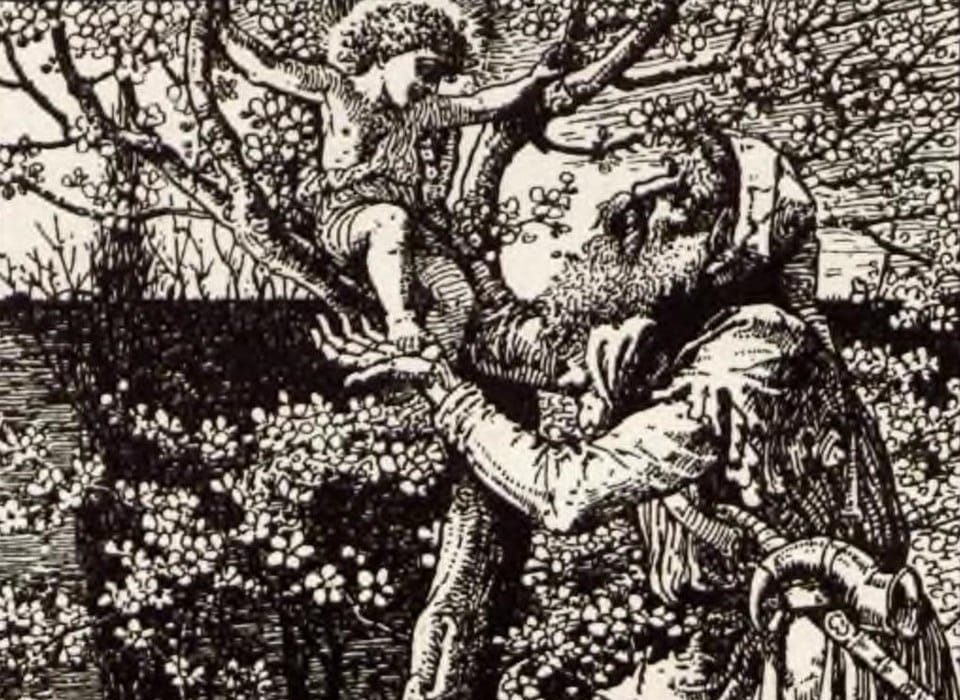
After a long time alone and without the spring, the giant wakes one morning and hears singing coming from the garden. He investigates and finds children in the playing. Overjoyed at their return, he then sees a small boy—much too small—trying to climb into the trees like the rest. This “melted” the giant’s heart and he went to help the child, which he does by setting him in the tree like the rest. With this action, the giant gave the garden to the children, having admitted to being selfish, and knocked down the wall he created to keep them out.

At the end of his life, the giant sees the little boy once more. However, now the boy tells him that he has come to take him to “Paradise” as the giant had shared his garden with the children.

Analysis of “The Selfish Giant”

This story is about magic in multiple ways—mostly love and redemption. The love of the giant proved a magical resource. Even though he was selfish, he was able to see through his own cruelty. He eventually becomes a decent person to the children (and steward of the garden). Additionally, through his redemption, the giant became selfless and caring, which benefitted more than himself.

Furthermore, we have religious allegory in this story, which often appears in fantasy fiction. The garden in which the children play is similar to Eden. The giant eventually shares this garden, and through magical/religious means, he is rewarded with paradise. This is afforded to him through the Christ-like child who takes him there.

At the end of the story, Wilde tells us that, “when the children ran in (the garden) that afternoon, they found the Giant lying dead under the tree, all covered with white blossoms.” White blossoms, while beautiful, also symbolize purity and innocence. Both of these characteristics the giant has regained through charitable spirit.

Conclusion

In “The Selfish Giant” by Oscar Wilde, the author tells tale of love, regret, and a changing heart. In a way, it’s Dickensian in scope. The scowling old miser learns his lesson, after all. By looking at this text and understanding both its religious allegory and allusions, the reader makes better sense of a world fraught with the haves and the have nots. Open your heart, the story tells us, and Paradise is yours.

Improving Syntax and Sentence Structure in Writing

Writers must stop and wonder about their craft often. If they don’t, then evolving as a writer becomes impossible. One way to guarantee an evolving writing style is exploring the fundamentals of writing. By understanding what makes grammar work and function, writers obtain a larger command of language and set better routines. In this way, understanding syntax and sentence structure in writing is important for writers, so they know the best ways to formulate words and sentences.

What is Syntax and Sentence Structure?

To put it simply, syntax is the way an author structures a sentence. The Guilford College Writing Manual states that syntax is a “joystick” that allows you “to control your style,” as it “refers to the way you arrange words in such units as phrases, clauses, and sentences.”

Additionally, Purdue asserts how a writer’s sentences are written and received are “matters of syntax,” and “as are the ways that different clauses are arranged and how they flow. Choosing different kinds of syntax allows writers to manipulate the qualities of rhythm and coherence throughout a piece of writing.”

Thus, if we consider syntax, then we are considering how to structure our sentences.

What are Three Syntax Considerations?

There are many elements of writing to think about when writing. Three aspects are worth your time and consideration: sentence structure, grammar, and creativity.

Sentence Structure

The top of the list is certainly sentence structure. If you are unfamiliar with different types of sentence structures just remember that there are four main types: simple, compound, complex, and compound-complex.

  • Simple: A subject and a predicate (also known as an independent clause).
  • Compound: Two or more independent clauses (simple sentences) joined with a comma and a conjunction.
  • Complex: One or more independent clauses joined by one or more dependent clauses (and a subordinating conjunction).
  • CompoundComplex: Two or more independent clauses joined by a coordinating conjunction and one or more dependent clauses (and subordinating conjunctions.

Grammar

It is important to understand the basic conventions of grammar in writing. That is to say, there are some elements that are absolutely essential for a sentence to work. For instance, capitalize the first word of every sentence, put punctuation at the end, use commas where necessary, and make sure your ideas flow clearly. The best way to get a handle on grammar is to practice writing simply and focus on simple and complex sentences to begin with.

Creativity

The best way to describe the final syntactical consideration is by asking a writer to go to their bookshelf and open their favorite book by their favorite author. Look at the first few lines of their story. What moves do they make as authors to get across their point?

For instance, consider these first lines from famous literary works and authors:

  • The Dead Zone by Stephen King: “By the time he graduated from college, John Smith had forgotten all about the bad fall he took on the ice that January day in 1953. In fact, he would have been hard put to remember it by the time he graduated from grammar school. And his mother and father never knew about it at all.”
  • Harry Potter and the Chamber of Secrets by J.K. Rowling: “Mr. and Mrs. Dursley, of number four, Privet Drive, were proud to say that they were perfectly normal, thank you very much. They were the last people you’d expect to be involved in anything strange or mysterious, because they just didn’t hold with such nonsense.”
  • To Kill a Mockingbird by Harper Lee: “When he was nearly thirteen, my brother Jem got his arm badly broken at the elbow. When it healed, and Jem’s fears of never being able to play football were calmed, he was almost never (concerned and a little worried about how you’re acting or what you look like) about his injury.”

The writers presented above use a conversational tone. However, consider that Rowling tone is a bit cheekier while King’s is a bit more colloquial. Meanwhile, Lee speaks to the youth of her characters and gives a sort of innocent retelling of events. With that said, each of these writers conveys their point clearly. We have a writing voice and that helps us convey information in our own way, whether we are informal or formal. Typically, a writers creativity and understanding of grammar and conventions guides their voice.

Conclusion

A helpful way to implement improvements in syntax and sentence structure in writing early on is to think while you write. More or less, writers should be aware of what they are doing while crafting. There are many people who write with fear, angst, and resentment, and with good reason–writing is hard. The trick is to find ways to ease the burden of the process so writers can be productive in their composing journeys.

The Real Identity of Alexandre Dumas’s The Man in the Iron Mask

In Alexander Dumas’s 1847 novel The Man in the Iron Mask, the three musketeers are once again united to defend honor and the crown. This time, they work together to replace the King of France with his twin brother–the titular Man in the Iron Mask. Yet, while much of this story is literary nonfiction, the kernels of truth are compelling. In fact, there was a real Man in the Iron Mask. With that said, historical mysteries are interesting because when they remain unsolved for centuries, speculation tends to overshadow factual accounts. This is definitely true in the case of the man in the iron mask, who was an unknown figure in history, likely imprisoned for political crimes against King Louis XIV.

France during King Louis XIV’s Rule

During King Louis XIV’s reign in France, there were massive cultural shifts in arts and religion. Meanwhile, the king worked to expand his control over government. At the same time, workers and peons of the kingdom suffered a great deal. According to folkloric tradition, times of strife create engaging stories. As in this case, the aristocracy in the country held a great deal of wealth, while the lower classes were taxed excessively.

There existed a massive wealth gap in the country, and the newly built Palace of Versailles exemplified the extravagance of the administration. There’s nothing quite like pouring out a chamber pot into a dirty street and looking up to see a resplendent castle that you’d never enter in your lifetime. The Palace exemplified rich life, as Louis held lavish feasts and grand balls.

Accordingly, the lower class lived horrible lives of work and toil. They had difficulty obtaining food and lived through cold winters where death lingered just outside the door. Their clothes and homes were drab and they lived in “homely villages.” The lives of the lower class were a plague unto itself.

As stated: “For those who called the Third Estate home in the 17th and 18th century, their state of living was not as desirable as that of the high nobility. Often taken advantage of due to high tax breaks given to the upper nobility, the largest percent of the population was mistreated despite making up the identity of France.”

It is important to highlight the unfairness of this period. This is so because it relates to King Louis’s lack of empathy toward people in French society. The following story shows this to be true.

History of The Man in the Iron Mask

Life and Times

Meanwhile, authorities during King Louis’s reign kept a prisoner in France’s dungeons for 30 years starting in 1669. The prisoner was forced to wear a mask around his head. While the name “The Man in the Iron Mask” is dramatic, it’s very misleading.

Instead of an actual Iron Mask as per images and depictions, he wore a black velvet mask. The creator of the mask had stiffened it with whalebone and used “steel springs which permitted its wearer to breathe, eat, drink, and sleep, without difficulty.” The mask was fastened on the back by a padlock.

J. A. Brendon writes that the prisoner was kept under lock and key. The mask became a part of his everyday life. He writes that, “He slept in it, prayed in it, ate in it; and two musketeers were detailed to shoot him at once should he ever dare to unmask,” Brendon states. “In the end he was buried, still wearing the mask.”

Throughout his life, the crown moved him between prisons that “corresponded with the successive postings of the prison governor Benigne d’Auvergne de Saint-Mars.” The prisoner was not allowed to speak with anybody at great length. The king and governor allowed words exchanged with an attendant to his cell and doctors over matters of health–but that was it as far as communication.

After his death, authorities went through great pains to remove his existence from the world. They scraped his cell of all markings, burned his cell door, along with his clothes, bedding and furniture.

But Who Was the Man in the Iron Mask?

Anna Blackwell writes in an 1860 edition of London’s Once a Week that the prisoner’s demeanor did not reflect the vulgarity and violence that one would suspect of such precautions.

She writes: “M. Nélaton described the masked patient as of dark complexion, possessing a voice so sweet and touching that it could not be heard without awakening sympathy; making no complaint of his position; grave and dignitied in manner, and having the air of a person of distinction: a description which tallies with that which was given of him to Voltaire by the son-in-law of the physician of the Bastille.”

Some sources allege that he was simply an Englishman, or the illegitimate son of Louis XIV known as Duc de Vermandois. Other identities have been hinted at as well, including kinship to Oliver Cromwell, the Duke of Monmouth, and the Duke of Beaufort.

As published in The Illustrated Magazine of Art, the prisoner could only have been “an Italian of the name of Matthioli.” Antonio Matthioli, according to the author, held the position of diplomat to the third Duke of Mantua. His dealings with King Louis resulted in charges of treason when he attempted to negotiate the sale of the fortress Casale to France. After the money for the deal was exchanged, Matthioli informed Spain and the Holy Roman Empire of what has transpired. As some have claimed, this led to his imprisonment as the man in the iron mask.

Regardless of conjecture, historians still debate the identity of the man in the iron mask.

Works Cited

“Matthioli: The Iron Mask.” The Illustrated Magazine of Art, vol. 2, no. 10, 1853, pp. 222–23. JSTOR, http://www.jstor.org/stable/20538126. Accessed 11 Feb. 2025.

Brendon, J.A. “The Man in the Iron Mask.” Historical Periodical. Feb. 1922.

Blackwell, Anna. “The Man in the Iron Mask.” Once a Week, vol. 3, Iss. 61, 25 Aug. 1860.

Creating Simple Sentences for Stronger Writing

As writers, we should know our craft, and, unfortunately, part of that is grammar. I say “unfortunately” because English grammar is really hard to understand sometimes. Yet, the more you know the better off you will be when it comes time to write. With that in mind, the best place to start is always at the beginning. Of course, we can skip the letters and sounds that we learn when we are children, but we need to start at a foundational point. This point is known as “the simple sentence,” which is also known as a subject and a predicate. Creating simple sentences in writing can help create stronger writing.

What is a Subject?

To put it plainly, a simple sentence has a subject and a predicate. Both of these elements make up the simplest sentence type. But, what are the subject and predicate made up of as far as words?

A subject is what the sentence is about. What this means is that the subject is the noun or noun phrase (person, place, or thing) that appears in a sentence. They often appear at the beginning of a sentence.

Let’s take a look at this example:

Larry played his guitar.

In this sentence, Larry is the subject, because that is who or what the sentence is about. Additionally, Larry is a proper noun. Thus, it fulfills the requirements of being a subject.

Still confused? Work in reverse by asking yourself what the subject is doing.

So: who played the guitar? The answer is Larry.

In other words, who or what is performing the action of the sentence? In this case, who is playing the guitar.

Here’s another example:

The house was on fire.

In this sentence, the house is the subject because that’s what the sentence is about. It’s the noun.

Still confused? Work in reverse by asking yourself what the subject is doing.

So: what is on fire? The house is on fire. Here, the word “was”is acting as a verb, so that’s the action.

As such, the house, much like Larry, fulfills all the requirements of being a subject: it’s a noun and it’s doing something (an action).

What is a Predicate?

A predicate in simple terms is what the subject is doing, or, as some put it: the rest of the sentence. This is also the verb part of the sentence or the action.

Look at your subject like the VIP of the sentence: he/she/they/them. It is the most important part of the sentence, so we can move them off to the side. Now, we can identify the predicate. In this case, it is what the VIP is doing—the action they are performing—and it’s the rest of the sentence. This part we can think of as the fans of the VIP. They are just straggling along to follow the subject.

Consider the example “Larry played his guitar.” In this instance, “played his guitar” is the predicate.

For the second example, “The house was on fire,” “was on fire” is the predicate.

Conclusion

There are many rules and parts of speech to contend with. There are also a variety of sentence types. Yet, you really need to start at the beginning in order to understand how sentences are written. Identifying the subject and predicate helps you understand basic grammatical constructs. It also helps you identify the parts of a sentence that make it a sentence. Once you get that down, you are already on your way to mastering the craft.

Reading, Writing, and Reciprocity

The Writing Post

Reading, Writing, and Reciprocity

Skip to content ↓