Category Archives: Folklore

The Real Identity of Alexandre Dumas’s The Man in the Iron Mask

In Alexander Dumas’s 1847 novel The Man in the Iron Mask, the three musketeers are once again united to defend honor and the crown. This time, they work together to replace the King of France with his twin brother–the titular Man in the Iron Mask. Yet, while much of this story is literary nonfiction, the kernels of truth are compelling. In fact, there was a real Man in the Iron Mask. With that said, historical mysteries are interesting because when they remain unsolved for centuries, speculation tends to overshadow factual accounts. This is definitely true in the case of the man in the iron mask, who was an unknown figure in history, likely imprisoned for political crimes against King Louis XIV.

France during King Louis XIV’s Rule

During King Louis XIV’s reign in France, there were massive cultural shifts in arts and religion. Meanwhile, the king worked to expand his control over government. At the same time, workers and peons of the kingdom suffered a great deal. According to folkloric tradition, times of strife create engaging stories. As in this case, the aristocracy in the country held a great deal of wealth, while the lower classes were taxed excessively.

There existed a massive wealth gap in the country, and the newly built Palace of Versailles exemplified the extravagance of the administration. There’s nothing quite like pouring out a chamber pot into a dirty street and looking up to see a resplendent castle that you’d never enter in your lifetime. The Palace exemplified rich life, as Louis held lavish feasts and grand balls.

Accordingly, the lower class lived horrible lives of work and toil. They had difficulty obtaining food and lived through cold winters where death lingered just outside the door. Their clothes and homes were drab and they lived in “homely villages.” The lives of the lower class were a plague unto itself.

As stated: “For those who called the Third Estate home in the 17th and 18th century, their state of living was not as desirable as that of the high nobility. Often taken advantage of due to high tax breaks given to the upper nobility, the largest percent of the population was mistreated despite making up the identity of France.”

It is important to highlight the unfairness of this period. This is so because it relates to King Louis’s lack of empathy toward people in French society. The following story shows this to be true.

History of The Man in the Iron Mask

Life and Times

Meanwhile, authorities during King Louis’s reign kept a prisoner in France’s dungeons for 30 years starting in 1669. The prisoner was forced to wear a mask around his head. While the name “The Man in the Iron Mask” is dramatic, it’s very misleading.

Instead of an actual Iron Mask as per images and depictions, he wore a black velvet mask. The creator of the mask had stiffened it with whalebone and used “steel springs which permitted its wearer to breathe, eat, drink, and sleep, without difficulty.” The mask was fastened on the back by a padlock.

J. A. Brendon writes that the prisoner was kept under lock and key. The mask became a part of his everyday life. He writes that, “He slept in it, prayed in it, ate in it; and two musketeers were detailed to shoot him at once should he ever dare to unmask,” Brendon states. “In the end he was buried, still wearing the mask.”

Throughout his life, the crown moved him between prisons that “corresponded with the successive postings of the prison governor Benigne d’Auvergne de Saint-Mars.” The prisoner was not allowed to speak with anybody at great length. The king and governor allowed words exchanged with an attendant to his cell and doctors over matters of health–but that was it as far as communication.

After his death, authorities went through great pains to remove his existence from the world. They scraped his cell of all markings, burned his cell door, along with his clothes, bedding and furniture.

But Who Was the Man in the Iron Mask?

Anna Blackwell writes in an 1860 edition of London’s Once a Week that the prisoner’s demeanor did not reflect the vulgarity and violence that one would suspect of such precautions.

She writes: “M. Nélaton described the masked patient as of dark complexion, possessing a voice so sweet and touching that it could not be heard without awakening sympathy; making no complaint of his position; grave and dignitied in manner, and having the air of a person of distinction: a description which tallies with that which was given of him to Voltaire by the son-in-law of the physician of the Bastille.”

Some sources allege that he was simply an Englishman, or the illegitimate son of Louis XIV known as Duc de Vermandois. Other identities have been hinted at as well, including kinship to Oliver Cromwell, the Duke of Monmouth, and the Duke of Beaufort.

As published in The Illustrated Magazine of Art, the prisoner could only have been “an Italian of the name of Matthioli.” Antonio Matthioli, according to the author, held the position of diplomat to the third Duke of Mantua. His dealings with King Louis resulted in charges of treason when he attempted to negotiate the sale of the fortress Casale to France. After the money for the deal was exchanged, Matthioli informed Spain and the Holy Roman Empire of what has transpired. As some have claimed, this led to his imprisonment as the man in the iron mask.

Regardless of conjecture, historians still debate the identity of the man in the iron mask.

Works Cited

“Matthioli: The Iron Mask.” The Illustrated Magazine of Art, vol. 2, no. 10, 1853, pp. 222–23. JSTOR, http://www.jstor.org/stable/20538126. Accessed 11 Feb. 2025.

Brendon, J.A. “The Man in the Iron Mask.” Historical Periodical. Feb. 1922.

Blackwell, Anna. “The Man in the Iron Mask.” Once a Week, vol. 3, Iss. 61, 25 Aug. 1860.

The Ferocious Ogres of Folklore and Myth

According to folklore, Ogres are, in fact, not like onions. That is, while they actually do have layers, they are far more terrifying than their portrayals in media. For instance, ogres come in many shapes and sizes. This includes their description in famous literature, to their awesome power in roleplaying games.

History and Interpretations of Ogres

Ogres are often described as “hideous giants” that eat humans and come from folkloric stories passed through communities. As such, there are many depictions of the ogre monster. For example, the giants in Homer’s Odyssey and the giants in Jack and the Beanstalk.

However, their title comes from French or Italian etymology, and seems to relate to orgo or orco (“demon”). There is also some relation to mythological figures, such as Orcus. Moreover, there is a connection to the “cyclops of myth and heroic literature.” They share many of the same physical traits: large, carnivorous, and violent. These attributes define the modern view of the ogre. It also seems to set it apart from, say, your run-of-the-mill cyclops or giant.

Ogres Appearances in Folklore

Meanwhile, we see various interpretations of the ogre in Tales of Mother Goose. Specifically in the stories “Tom Thumb,” “Hansel and Gretel,” and “Little Red Riding Hood.” In the latter, the ogre-like wolf attempts to consume the heroine of the story.

As Cambridge Dictionary states (and others), ogres are “a large frightening character in children’s stories who eats children” (Cambridge). The cannibalistic or at least flesh-eating inclinations of the ogre seem to steer it toward a more taboo-breaking creature, as a giant (say from “Jack and the Beanstalk”) doesn’t necessarily want to eat people, but would rather stay in its high castle.

Furthermore, the fairytale “Puss in Boots,” the protagonist, Master Puss, embarks on an adventure and encounters a castle that was under the ownership of an ogre.

“He was the richest ogre that had ever been known, for all the lands through which the king had passed were part of the castle domain,” the story states. The ogre allows Master Puss to come into the castle and reveals that he can shape change into many different animals. Master Puss tricks the ogre into changing into a mouse, and he then gobbles up the ogre in his hubris.

Ogres Appearances in Modern Media

Likewise, the terrifying ogre of Dungeons and Dragons fame is described as a “hulking giant” that is “notorious for (its) quick temper.” An ogre “lashes out in a frustrated tantrum until it runs out of objects or creatures to smash” (D&D). If you’ve ever fought one of these pea-brained monster in Dungeons and Dragons, then you know they are difficult combatants. They have a lot of hit points, and the ability to smash your character into a pink mist.

Lastly, and as hinted at, the most well-known modern interpretation comes in the classic kids-film Shrek, where the ogre is a big, green, and soft-hearted monster who lives in a swamp. Shrek stands in contrast to what we know of the ogre–for the most part–as it seems as though his monstrous personality is just a front to keep villagers away from his home.

Conclusion

Ogres, as with most monsters of folklore, aren’t just one thing. Think about vampires. How many stories are there that characterize vampires in different lights? From the viscous Vlad the Impaler to the sensual Lestat de Lioncourt from Anne Rice’s 1976 novel Interview with the Vampire, to the horrifying nightmare child in John Ajvide Lindqvist’s 2004 novel Let the Right One In.

Much in the same way, we find overlap in the ogres’ stories with that of other monsters, from the werewolf’s often lumbering persona to a zombie’s insatiable bloodlust. All of this to say: maybe ogres really are more complicated than we acknowledge.

Spring-Heeled Jack: Folklore and the Supernatural

“Enchanted by that dark and mist-blown strawberry spring, and by the shadow of violent death that walked through it on those nights eight years ago. The shadow of Springheel Jack.” – Stephen King | Strawberry Spring

Victorian England, a time of cultural and economic prosperity, was also home to murderous figures who stalked the streets. Jack the Ripper was one such serial killer who killed and mutilated multiple women near White Chapel. However, his story is both plausible and true–it actually occurred. Nonetheless, some stories require a bit more fantasy. Spring-Heeled Jack, the Leaping Terror of Victorian England, for instance, is this sort of fantasy, as he bounded over walls and attacked people on his way through London.

Victorian England

Name and Factors

Before the story of Spring-Heeled Jack, let’s discuss the years between 1837 and 1901. Historians know this timeframe as the Victorian Era, as Queen Victoria reigned supreme during this time. In this age of decadence, the high society of Britain was doing extremely well. They enjoyed a booming economy and a rich culture. Many people voted and two-thirds the working class made up the empire.

Some key factors that contributed to this economic prosperity included the Industrial Revolution, imperial control, and scientific innovation. Meanwhile, in the arts, Charles Dickens, the Bronte sisters, and Oscar Wilde contributed literature that would shape the writing world. Pretty much, from top to bottom, the country was alive with economic and cultural movement in a positive direction.

The Price of the Era

But such resplendence often comes at a price: industrializing countries have many issues, including child labor, poor working conditions, and wealth inequality. This was also true in England. If you weren’t working in any of the factories that dotted the city, then you were working as a railway worker, or you worked at the docks, or you and your children spent time in the coal mines. Additionally, social class kept a separation between the upper aristocracy and the lower poor. There was very little in the way of upward mobility. If you were born in the poor slums of England, then you died in the poor slums of England.

A Focus on Morality

Similarly, the morality of the era focused on modesty. The fixation on modesty contributed to high society considering some topics “improper.” The morality kept under check included “sexual proprietary, hard work, honesty, thrift,” and a “sense of duty and responsibility toward the less well off” (2).

Artists of the era took note, and some even faced ostracism. Aurhorities removed Oscar Wilde, playwright and novelist, from his high-status life due to homosexual acts. Wilde once wrote: “The books that the world calls immoral are the books that show the world its own shame.” Often, in the pursuit of modesty, those perceived as immodest are unduly punished. 

The Anatomy of Spring-Heeled Jack

Yet, within these prosperous confines, smoky streets, and industrialized neighborhoods, murderers lurked. They included Jack the Ripper, Mary Ann Cotton, Amerlia Dyer, and the titular Spring-Heeled Jack. 

While Spring-Heeled Jack’s appearance varies from account to account, the basic values are as follows:

  • Devilish, with clawed hands.
  • Eyes: Glowing red eyes
  • Clothing: Wore a black cloak, oilskin suit, helmet.
  • Abilities: Able to leap great heights and exhale blue flames.

Appearances of Jack and Timeline

The spectral, supernatural figure of Spring-Heeled Jack first appeared in the early 1830s. Author Karl Bell stated that local villages began reporting a “phantom bull or bear,” around their communities. Then, the more actualized appearance of Spring-Heeled Jack came into focus. He was “a tall, dark, cloaked figure who pounced upon individuals, predominantly women” (3). 

One of these earlier accounts included a woman by the name of Mary Stevens. She claimed to have seen Spring-Heeled Jack in London around 1837. He attacked her but then sprang away from her scream. Similarly, in 1838, a woman by the name of Jane Alsop stated that a policeman knocked on her door. When she answered, he attacked her with claws and spat blue fire at her before leaping away. 

Later, in the 1870s and 1880s, Spring-Heeled Jack was spotted again, and even though he was fired upon by soldiers, he escaped unscathed. In time, Spring-Heeled Jack faded away into history, but his lore still lives on. 

The Identity of Spring-Heeled Jack?

There have been a variety of assertions as to Spring-Heel Jack’s personage. Some are convinced it was the Marques of Waterford, who started the story for his own amusement. If we consider the idea of “modesty” during this age then it stands to reason that it would indeed be improper of a Marques committed the evil acts of Spring-Heeled Jack.

Others claim that it was similar to both the werewolf phenomena and the Dancing Plague of Medieval England. That is to say, mass hysteria took hold. Considering it was a chaotic age of evolution and technology, there was still the spirits of violence stalking the corridors. The aforementioned Jack the Ripper murdered and terrorized the city. Spring-Heeled Jack, too, could just as easily manipulate his way into the human psyche through hysterical attitudes.

Finally, more theological and conspiratorial minds state that he was in fact some kind of Devil or an alien from a distant planet here to spring-heel his way through England. These connections are more tenuous, but the church’s prominent role in Victorian England could lend itself to demonic accusations. As for aliens, the endless fascination of outer space and visitors from other worlds lends itself to an errant, galactic invader.

Conclusion

In a similar vein to other folkloric creatures like the Loch Ness Monster and Bigfoot, Spring-Heeled Jack lives in myth. He has been sighted by some (mostly country dwellers). His legend thrives on fragmented reports, sensational newspaper articles, and the Victorian fascination with the supernatural. 

Meanwhile, the police accounts for Spring-Heeled Jack seem pieced together and based on speculation. They read very similar to how the police handle investigations today, while trying to get ahead of public hearsay. That is to say, a common murderer can be turned into a 20-foot tall beast on a dime based on the victim’s account.

Either way, unlike more supernatural creatures from England, Spring-Heeled Jack will live on as a real threat for his fearful demeanor, violent actions, and association with the age of decadence in England. 

Jack-o-Lanterns, Folklore, and the Devil

A pumpkin is just a pumpkin. A turnip is just a turnip. Carve a face into them and suddenly you have a jack-o-lantern. While these carved-out, festive fruits are something to behold, they also have a mythic history to them altogether. These stories carry a deeper connotative meaning then just spooky faces to put on your doorstep. In fact, jack-o’-lanterns may be one of the most important objects in the modern Halloween tradition.

What Makes a Jack-o-Lantern a Jack-o-Lantern?

To start, jack-o’-lanterns are literal pumpkin lights. People cut the pumpkin “to resemble a human face.” With that, they become jack-o’-lantern. These contain the popular pumpkin grin and candle. A more botanical definition describes pumpkins as “a large, orangish gill fungus that is poisonous and luminescent.”

A “Jack with the lantern” or “Jack of the lantern” refers to somebody “with a lantern or a night watchman.” This stems from Britain, where watchmen would refer to men they didn’t know by a “common name like Jack.” The term also refers to the aforementioned “Jack with a lantern” or the bog gas known as “ignis fatuus” that “often leads travelers to destruction.” These are a few “stock” definitions that describe what a jack-o’-lantern is, but the lore of jack-o’-lanterns goes much deeper.

The Jack-o-Lantern Folklore

Every jack-o’-lantern comes with the heavy weight of history, specifically Irish folklore. Back in the mid-1800s, children would carve jack-o’-lanterns out of vegetables and place candles inside to create a haunting visage around Halloween . This tradition added a unique touch to the season.

There is also a story about the name “jack-o’-lantern” and its origin in Irish tradition. According to legend, a blacksmith named Stingy Jack and the Devil were having a drink, but Jack didn’t want to pay when their drinking session was over. He convinced the Devil to turn into a coin to pay, and then Jack trapped the Devil near his pocketed cross. Later, Jack again trapped the Devil, this time up a tree, by carving a cross into the bark.

After Jack died, part of his bargain with the Devil was revealed: the Devil could not take Jack’s soul, as per one of their agreements. Additionally, the Lord would not allow Jack into Heaven due to his questionable life on Earth. So, Jack was kept out of both Heaven and Hell, forever wandering the Earth with a solitary coal to guide him through the dark. Jack “put the coal into a carved-out turnip and has been roaming the Earth with it ever since.”

Types of Jack-o’-Lanterns and Modern Usage

Depending on where you live, jack-o’-lanterns were carved from a variety of different fruits and vegetables in the past:

  • In Ireland and Scotland, people carved faces into turnips and potatoes.
  • In England, people carved jack-o’-lanterns from large beets.

Moreover, in Ireland, “people cut out heads and faces of turnips.” They then “hid them in the hedgerows as a prank during Hallowe’en” according to BBC. This may possibly be a better explanation for the jack-o’-lantern’s genesis. Things changed when immigrants came from overseas to the US, where pumpkins became the next best thing.

Conclusion

Jack-o-lanterns are an important function of the season. They provide an easy decoration and also a chilling image of the connotative, spiritual power of the holiday. They also remind us to stop and reflect on why we celebrate certain aspects of the Halloween. After all, a pumpkin may be just a pumpkin, but after we cut it open–we have symbolically embraced a whole world of folklore and tradition.

Was Halloween Built on Sacrifice? The Truth Behind Samhain

In Ray Bradbury’s The Halloween Tree (1972), a group of boys are whisked away on a magical Halloween eve and venture through time to learn the true meaning of Halloween. They encounter many obstacles and a great deal of folklore in the process. Some of it is true and some of it not true. All of it is laced with darkness. But just how sinister is it really? While there are many allegations that the ancient tradition of Samhain is actually a sacrificial party for pagans, there seems to be no first-hand accounts of this fact. In actuality, the folkloric origins of “sacrifice” have more to do with propaganda and less to do with tradition. 

Sacrificial Origins

The Celts and Halloween

The Celts have had a significant impact on our modern understanding of Halloween. Much of the celebration and nuances, such as treats and celebration, come from these early stories. Allegedly, they started large pyres as a crux for celebration, and they danced in the embrace of “Samhain” (pronounced “sow-win”). The celebration lasted from October 31st through November 1st (Gershon).

As the folklore goes, the bloody history of Halloween included sacrifice and murder to keep the spirits at bay. The dead would stay beyond the walls of the living, until that wall became thin. Some researchers indicate that this was a time when the “nights grew longer and vegetation died off, the sagas represented doors opening between the lands of the living and dead” (Gerson). And through these doorways stepped the deceased ancestors previously laid to rest.

The Giants of Sacrifice

These stories state that the Celts sacrificed their children, grains, and cattle to the Fomorians of Irish Mythology. The Fomorians were a monstrous race of hostile ne’er-do-wells. These Fomorians would eat and consume and destroy unless plied with sacrifice to appease them.

As written in The Irish Post: “According to the ancient ‘Book of Invasions’, each Samhain the people of one Irish village sacrificed two-thirds of their children, their corn and their milk to the supernatural Fomorians,” and, “According to the later Dindsenchas and the Annals of the Four Masters – which were written by Christian monks … that a first-born child would be sacrificed at the stone idol of Crom Cruach every Samhain.” 

However, Halloween history contains a plethora of myth. Thus, it seems many historians interpret the Fomorians as symbolic of nature and its destructive forces. Still, superstition shaped the rituals of the time.

Sacrificial Charges

Strabo and Geography

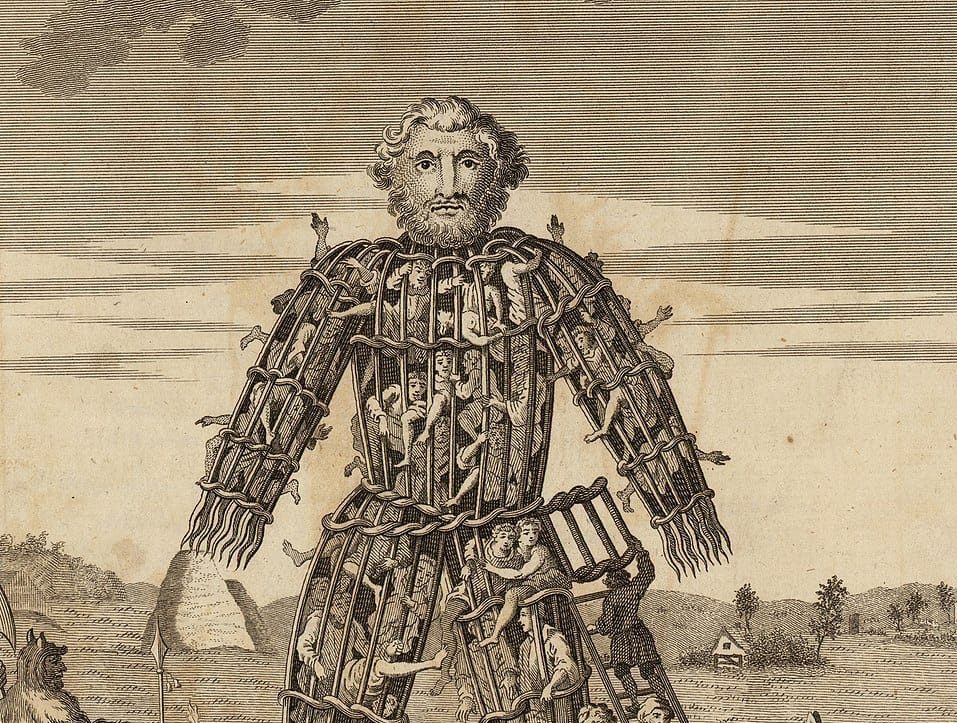
Greek Philosopher Strabo explains in Geography that out of superstition the Celts created massive figures composed of straw and wood. They used these figures for the alleged sacrifices. According to some researchers “… Strabo records that ‘cattle and wild animals and all sorts of human beings’ were thrown into this colossus. It was then set on fire. Strabo also asserts that the ‘wicker man’ was just one method of human sacrifice …” The druids would also, “shoot victims to death with arrows, or impale them in the temples” (Mingren). 

In Caesar’s Own Words

The sacrificial claims don’t end with Strabo. Julius Caesar himself alleged that the barbaric tradition was happening just outside the borders of Rome. In De Bello Gallico, Caesar wrote, “They (Gauls) believe, in effect, that, unless for a man’s life a man’s life be paid, the majesty of the immortal gods may not be appeased …” Which means that a human must sacrifice themselves to make the Gods happy. He also writes, ” … and in public, as in private life they observe an ordinance of sacrifices of the same kind.” So, here sat the head of Rome, and he believed through the stories relayed to him that the enemy burned their own countrymen.

Caesar also wrote that some of the Gauls used “figures of immense size whose limbs, woven out of twigs,” were stuffed with living victims and set ablaze. “… the men perish in a sheet of flame,” he stated. “They believe that the execution of those who have been caught in the act of theft or robbery or some crime is more pleasing to the immortal gods. Yet, when the supply of sacrifices fails they resort to the execution even of the innocent” (Tastes of History). These allegations create a visceral image of bloodthirsty heathens waiting to bombard the Roman populace with their pagan ways. Thus, Rome’s narrative of a less civilized enemy held true in history as well, whether fact or fiction. In so many ways, Caesar’s own writings enabled the barbaric perspective of the Celts to take hold onto history. History is written by the victors.

Contrary Opinions

The Druids and Sacrifice

It’s important to note that Caesar may have been embellishing a bit. It is pure speculation whether there were actual human sacrifices even in the most famous instances of presumed sacrifices. Researchers are unsure if some of the remains of historical sacrifices were actually the result of “a homicide, a violent robbery, or the execution of a criminal” (National Geographic).

As stated by Irish Central: “As of yet, no human remains have been found within a Celtic Gallic sanctuary that clearly indicates a violent death. In the case of singular skulls or headless bodies, decapitation appears to have taken place after death, and one cannot be certain that these humans were alive, or even intact when they arrived at the sanctuary.”

All the same, it should be noted that researchers believe the “Lindow Man” was a human sacrifice. As stated, his “head had been violently smashed,” and “had been strangled and slashed.” The reason for his sacrifice is a mystery. Though, some researchers have pointed to the Druids’ fears of continued Roman invasion (Owen). Therefore, a sacrifice may have seemed necessary. Yet, one instance of human sacrifice is an outlier. This does not mean the Druids were killing people for their festivities in order to keep the spirits from harming them (Krul). 

Rome and Propaganda

The deaths related to sacrifice “predate the Roman era.” As such, it is difficult to ascertain whether Caesar was embellishing for propagandistic purposes or not. However, considering the fearsome depictions of the Gauls in Roman society—Caesar’s intentions may not have been historically benevolent. After all, physical victory over the Gauls was essential for Caesar. By demonizing their culture, he won the psychological war as well.

Additionally, a few sources speak to the idea that the Celts committed sacrifices in their time. Still, many of the sources either point to Strabo or Julius Caesar, who were not present at these celebrations and were pushing a pro-Roman/Greek narrative that overhyped the barbaric nature of the enemy.

Conclusion

The Romans eventually conquered the Celts and their culture, and adopted the Celtic celebration of Samhain into both Feralia and Pomona. The former was a day of the dead and the latter was to celebrate apples. These celebrations, plus those of Samhain, have lived on in various ways, from eating snacks to playing tricks or dressing up in costumes.

But, just as those traditions have lingered, so has the brooding nature of Halloween as an evil holiday that has links to the Devil and human sacrifice. Certainly, folklore in this way has created a negative connotation for some cultures and traditions pas and present. The fears of Satan and Halloween still crop up, and evildoers still allegedly stuff candy with razorblades. In some cases, these connective strands from evil to Halloween have created improper impressions. In this instance, the uncivilized held an obsession with human sacrifice. Yet, these charges come from the words of conquerors. Either way, the modern Halloween tradition is devoid of human sacrifice, which means you can still trick-or-treat without fear of sacrifice.

The Violent Crimes of the Werewolf of Bedburg

In the annals of lycanthropy, there are many stories of violent crime against humans from one with wolf-like attributes. The story of Peter Stumpp is one such story. Historians and speculators have immortalized his crimes in the history books, as judiciaries of the era accused Stumpp of lycanthropy. Not exactly a modern crime. But just like the infamy of the Witches of Salem, today the public knows Stumpp as the Werewolf of Bedburg. Unfortunately, his crimes go beyond simple murders by moonlight.

The Medieval Setting

When the world was in the throes of medieval tyranny–aka the Dark Ages–there were many atrocities that assailed humanity. War, famine, disease, and torture were all realities of life. To be a serf or a laborer, meant an exhausting existence of pitiless cumber under the barons and lords of feudal society. 

These lowly workers also dealt with the inexplicable. 

Take for instance, the Dancing Plague of 1518, in which citizens of Strasbourg, France, danced uncontrollably until they grew fatigued or died. A strange circumstance, but mass hysteria has a way of controlling those of limited education and intelligence. In the case of the Werewolf of Bedburg, multiple killings drove the community into a frenzy of fear and vengeance. Yet, the enemy was extremely stealthy, and as legend states–had the ability to shapechange.

Background of Violence

A werewolf, simply put, is “a person transformed into a wolf or capable of assuming a wolf’s form.” These fairy tale creatures began to take a truer form in Medieval society due to exceptionally gruesome murders and killings in rural communities. While sources typically point to undiagnosed psychological issues and hysteria, for serfs and laborers, these hounds from hell were very real.

In Europe between the years of 1564 and 1589, cattle mutilations and slayings occurred in and around the small village of Bedburg in Germany. The villagers first discovered desiccated cattle, which something had violently slaughtered and eaten. Later, the bodies of local townsfolk began to appear, bloodied and stripped of life and dignity. Of course, the thought of a frenzied wolf-man committing these atrocities did not seem likely. Nevertheless, for nearly a decade, the killer stalked the wilds around Bedburg, hunting for hapless victims that included men, women, and children. 

The Werewolf Strikes

Nobody in the village knew who to suspect, but as with most undetected killers, they are typically the ones we least suspect. Peter Stumpp (or Stubbe, or Stumpe, or Stumpf), lived near Cologne, Germany, in the 1500s. While he was a farmer in his work life, he also spent his private time looking for victims in the community. In a similar vein to Sawney Bean in Scotland, Stumpp found the weakest in society, and preyed up on them.

“Peter started by murdering, in wolf-shape, anyone who displeased him, plus their relatives,” states Nancy Garden in Werewolves. Accordingly, he hunted the helpless because they were easy to overpower. Garden adds, “Often he went through the streets, well-dressed and polite, even saying hello to friends and relatives of people he had murdered. Then, in wolf-shape, he would kill their lambs and goats, and their daughters, too, when he had the chance.” 

After years of murders and attempts to capture the killer, the locals finally stopped Stumpp. Unfortunately, the death toll in Bedburg had become too much, with the discovery of human limbs (arms and legs) in the surrounding fields. With fervent veracity, a group of locals and hunting dogs captured Stumpp after cornering him in the forest. As if to spite the hotly sought after murderer, the authorities decided to torture the confession out of Stumpp.

The Devil’s Belt

Under pain of torture–a breaking wheel (wooden rack)–Stumpp admitted to consorting with the Devil. He claimed to have worn a belt that allowed him to turn into a wolf-like entity that was voraciously hungry for meat and flesh. In this form, Stumpp allegedly killed man, animal, and his own kin (eating his own son’s brains). The courts convicted Stumpp of killing 16 people, including 13 children. The judges sentenced Stumpp to death, and executioners tested his mortality on Oct. 31, 1589. 

As some sources state “… Peter Stubbe was tied to a wheel and flayed, broken, decapitated, and burned at the stake, at each stage the tools used by his executioner invoked aspects of the crimes they were meant to punish, ‘thereby mapping the misdeeds on to the body of the criminal’” (Brown). In a likewise grisly manner, other sources point out that torturers ripped Stumpp’s skin and flesh with “hot pincers,” and his arms and legs were “broken with the blunt side of an axe before his left hand was cut off.” Stump, a violent murderer, met a fate just as grisly as the ones he

Conclusion

The story of Peter Stumpe, the Werewolf of Bedburg, is a violent one. From his own murders of men, women, and children, to his harrowing execution, he lived a life of misery. Similarly, those that fell under his animalistic insanity were also grimly disposed of by his violence. Stumpe’s admission in court is still analyzed to this day. It should be noted that his story reminds us that insanity was left undiagnosed in Medieval times, and the thought of werewolves explained excessive violence when saner explanations were left unfound. 

Works Cited

Neumann, Sean. “His Son and Other Murders. Was He Really a Killer, or a Victim of Mass Hysteria?” People, 1 Feb. 2025, Web. 

Walter, Katie L. “Review of Flaying in the Pre-Modern World: Practice and Representation, by Larissa Tracy.” History, vol. 104, no. 360, Apr. 2019, pp. 331-334.

The Boggart, Folklore’s Little Prankster

There are many iterations of violent cryptids out to harm humanity throughout folklore. You have your dragons, medusas, ogres, and vampires. Sometimes, though, you have some annoying but helpful ones. The Brownie in Scottish mythology is one of them, and so is this post’s topic: the Boggart.

History of the Boggart

In a traditional sense, a Boggart is anything supernatural in nature. This includes ghouls on the moors and spirits in the night. The creature is a short and smelly monster covered in hair, like a miniature bigfoot. Its very presence seems to be of ill-tidings for families. It has the ability to make the household pets run in fear and one’s milk to sour on its own. Imagine Death himself walking by a flower and watching it turn gray and die. That’s like a boggart, but with curdled milk.

The Boggart’s first appearance was in Traditions of Lancashire by John Roby. In it, Roby discusses the Boggart’s nefarious attitude toward a farmer and his family.

Roby writes that the Boggart antagonized the family “with numerous pranks.” The Boggart took the children’s food, threw their drink on the ground, and even scared them at night. Outside of Roby’s research, Boggarts are also known to play many more tricks on people. For instance, they rip the sheets off people while they are sleeping. They also lay their cold hands on them and pinch them.

Even if you and your family are sick of these little fellows, you can’t easily rid yourself of their menace. They typically follow families from place to place.

Conclusion

There seems to be only one way to rid a Boggart. This includes hanging a horseshoe upside down over a doorway to prevent their presence in your home. Nevertheless, though the Boggart has its own folklore, there are some discrepancies as to what the creature is actually. It may just be a spirit or a little gremlin from a dark fantasy film. A hobgoblin? Maybe all of these things!

However, the Boggart does serve a purpose. If it is a bothersome pest in some area, it might just be a protector. Likewise, it offers a convenient excuse for kids to act nicely because the Boggart was a tool of intimidation. That is, children were more apt to act nicer if they knew a little hairy beast was watching. Either way, whether dastardly or helpful, the Boggart is truly a wonderfully strange creature.

Wendigo Analysis: Origin, Description, and Symbolism

The cold and forbidding forests of Canada and Northern Michigan are home to a plethora of natural wonders. Surely, the frozen landscape is beautiful enough. But when the winter wind howls and the trees crack–surely something evil creeps in the frightful dark. In Indigenous cultures, the beast goes by the name “wendigo.” This post will analyze the lore around this monstrous creature and see how the strength of folklore influences culture and history to this day.

The Origins of the Wendigo

The most pressing connotation of the wendigo is that of the abominable snowman—lurking in snowy forests in secluded regions around the world. However, as mentioned, the wendigo (or windigo) actually materialized out of the First Nations tribes in Canada, or Algonquin folklore.

Some sources tells us that the windigo “legend existed in Algonquian oral history for many centuries,” and previous to the arrival of Europeans on the continent. In 1722, a “French traveler Bacqueville de la Potherie” recorded the first appearance of the word, but it appeared as “Onaouientagos.” Explorers did not understand the portentous nature of the beast at the time. Nonetheless, through oral storytelling and sightings we now are more familiar with an abominable snowman-type beast.

Physical Description

Researchers have described the monster in a variety of ways. However, there is consistency to these descriptions.

Oftentimes, stories portrayed the beast as having “glowing eyes, long yellowed fangs, terrible claws and (a) long tongue.” This description provides a terrifying picture of the monster. As reported, the beast is a violent creature with “yellowish skin” and one that is “matted with hair or (has) decaying skin,” which gives me the impression of a large, rabid dog.

As described by Legends of America, the wendigo is a “monster with some human characteristics” and it has been “historically associated with cannibalism, murder, insatiable greed, and cultural taboos against such behaviors,” which paints a menacing portrait.

The Wendigo: A Symbolic Meaning

Explaining Madness

On the surface, the wendigo’s existence is that of a horrible monster, often huge and ravenous, menacing the frozen forests of the North. But connotatively, we have something far more nuanced. The wendigo is a representation of natural phenomena and the danger of nature. It is the wind, the trees, the hills…the snow.

When not representative of nature, the wendigo embodies the aforementioned characteristics of greed, cannibalism, and murder: “… the word also functions symbolically to connote gluttony and the ‘image of excess’” writes Marlene Goldman in “Rewriting Apocalypse in Canadian Fiction.” When new arrivals emerged from Europe, a straightforward way to explain their xenophobic, homicidal mania was to liken it to a beast of legend: why else would the invaders be so ruthless and bloodthirsty?

In addition to that, the legend of the wendigo explains a community member’s unexplained madness and violence. An uncle murdered your aunt and cut her to bits? If he had never even seemed remotely violent, wouldn’t that confound your relatives and the community at large? Why not suggest that the supernatural is plausible in a society that worshipped both spirits in a variety of forms?

Furthermore, as posited by Katarzyna Jusiak in “The Embodiment of the Taboo: The Images of Wendigo in Literature and Their Rendition in Modern Media.,” the wendigo is a multifaceted creature whose appearance, and meaning, is dependent on the presenter, whether that be the Canadian image, which adheres to a “traditional image known from oral culture,” or the image of the wendigo as a predator, “preying on grief of those who lost someone loved instead of the necessity of devouring human meat in the wilderness…” (Jusiak 31).

Remember: the cultures of days gone, whether those of antiquity or even farther back, needed to explain the world to their children through an oral medium. These could be Indigenous cultures or settlers establishing a state. Thus, creating a boogeyman helped people understand the bad-faith actors in other societies and their own. These people who were feverishly destroying cultures and propagating a new narrative of civilized life could only be literal monsters.

Explaining Imperialism

Aptly, in an article title “Boogie Men” on Mohawk Nation News, writer kahntineta writes that the Windigo is “sick because it’s cut off from its roots” and that “its hunger knows no bounds … When it sees something, it wants to own it.”

The author refers to this thirst as “Windigo Psychosis” or “Owistah disease.” While researchers hotly debate this idea, the terminology is in reference to despicable characteristics in humanity. For instance, the insatiable lust for destruction that resulted in the genocide of Indigenous cultures. And the violence that occurred to people when imperialism came to the shores of North America.

With that said, it is clear that the wendigo is not just a literal snow beast that lives in the snowy parts of the world. Rather, it is a metaphor for the actions committed by a person or society that commits violence and atrocities. In other words, those who murder, or rape, or cannibalize another’s life or community has the Wendigo disease–literally or figuratively. So, societies afflicted with this psychosis allow genocide and the mass destruction of cultural heritage.

“They (settlers) were unchained from the morality of human feeling,” kahntineta states.

Conclusion

It is my belief that symbolism is heavy in the hands of the believer, whether they know it or not. What I mean by this is that believers in supernatural ghosts, goblins, and werewolves—possess a particularly important interpretation of the world. This interpretation symbolizes reality and places it into a contextual framework.

At first, one might say that this is a dangerous outlook. Belief in the unverifiable attaches itself to conspiracy or downright lunacy. However, respect for folklore and oral tradition can create a sort of unintentional explanation of reality. That is to say, the Bigfoot can represent the rejection of a peremptory government, and the Paulding Light represents our society’s reverence for the dead. Sure, we can believe that these phenomena are real, but that does not create any new understanding for society. It just creates mystery, but that is not the point of folklore. We can either believe in a ten-foot-tall monster that roams the Canadian outback, or we can understand that these uncertainties echo the horrors of history.

The wendigo embodies the worst, most fragmented aspects of our culture. Yet, it also forces us to reflect on those aspects to aspire to greater heights of humanity and morality.

The Minnie Quay Ghost Story: A Haunting on Michigan’s Shore

There is a recurring motif in Michigan folklore that deals entirely with the savagery of the waters. The Singing Sands of Bete Grise tells the tale of a young indigenous woman who lost her lover. How did he die? He drowned after his canoe tipped on the waters. Meanwhile, the Lilac Room ghost in Marquette speaks of a woman whose lover, a sailor, disappeared on a merchant vessel. There are multiple ghost-ship stories in Michigan’s history. According to legend, those ships pop up in the fog on the horizon from time to time. The Le Griffon, for instance. Another such tale is the Minnie Quay ghost story.

The Story of Minnie Quay 

As the story goes, Minnie lived in Forester Michigan, which is located out in the thumb and to the north of Port Sanilac. According to the Huron Daily Tribune, the Quay family moved to Michigan from New York in the 1860s. “Her father was an engineer for a local lumber mill in Forester that used to be one of the many bit shipping towns along Lake Huron,” writes Dominic Sevilla. 

Lake Huron by Topher is licensed under CC-CC0 1.0

In and around 1876, Minnie fell in love with a sailor. Her paramour frequently left for work on the waters around Michigan aboard various ships. Minnie’s parents forbade her from seeing this sailor for unknown reasons. Her parents reservations may have been related to sailor transience. But, Minnie, 14-16 years old at the time, impetuously disobeyed her parents’ wishes. 

On the day Minnie learned of her lover’s death, she could not stifle her anger. Her parents had kept her from seeing him before he left on what would be his final voyage. Now, they could not stop her adolescent rage. Not long after the news shattered her world–a few days maybe–she walked into town, past some of the locals, boarded the dock, and jumped into the waters of Lake Huron, killing herself. 

As reported, Minnie Quay “committed suicide by throwing herself into the lake from Smith’s dock, at Forester.” What is more, her brother watched her jump from the dock and into the waters. As stated: “A quick alarm was given, and men commenced at once to grapple for the body, but it was an hour before it was discovered … No cause is assigned for this rash act.”  

Final Thoughts

Allegedly, one can walk out onto the beaches of Forester and occasionally find the ghost of the young girl. She appears to be waiting for her lover to return to shore. Others have claimed that her gravestone in the local cemetery broke open and her ghost escaped. Because of this, one must place a token on the stone to keep her from following. What’s more, some have even claimed that she has tried to get young girls to join her in the water. As with all folklore, even the Minnie Quay ghost story has some alternates.

Whatever the story, the dangers of the Great Lakes and the trauma of lost love are strong in Michigan history.  

Ghost Lake: The South Manitou Island Lighthouse Hauntings

Michigan has many strange things in the surrounding waters, and many haunted lighthouses on it shores. Allegedly, the spirits of the patrons and keepers still linger around the lighthouses. Regardless, the South Manitou Island Lighthouse hauntings are familiar occurrences in the Mitten state.

About the South Manitou Island Lighthouse Hauntings

The lighthouse was built in 1872 to help sailors navigate the Manitou Islands. It is located on the island in Lake Michigan, which is west of Leland, MI, in Leelanau County. The lighthouse has gone through quite an evolution in its time. From a “Lewis lamp” to the more modern Fresnel lens, the lighthouse has gone from a practical building to a more appealing coastal fixture. 

The Hauntings

Surrounding the South Manitou Island Lighthouse hauntings are a litany of deaths and disasters. There are also two cemeteries on the island, a ghost-filled forest, and the skeletal remains of an unknown person who had been buried in the sand. Furthermore, the wreck of the SS Francisco Morazan is off the coast of the island. It is a curious wreckage–curious enough to draw the attention of a child who died trying to explore it. 

Another story includes the drowning of “keeper A.A. Sheridan and his wife, Julia, and their infant in a boating mishap in March 1878.” From these drownings, the stories of their ghosts haunting the lighthouse have persisted for many years. Legend says that ghostly voices echo in the causeway between the house and lighthouse on the island. 

But there are other stories around the island that elude to a darker history, aside from your run-of-the-mill haunting. As stated by some reports, cholera-stricken passengers allegedly landed on the island at some point in history, where the sailors “buried them in a mass grave–some reportedly still alive.” This may just be a matter of legend, which stands in contrast to the wreckage of the Three Brothers, submerged in the water nearby. 

Conclusion

I have visited many of the lighthouses on the east coast of Michigan. I have found them all to be pleasant and historic in nature. Most have been kept pretty well through history. A fresh coat of paint does wonders to keep something from looking so dark and forlorn. The ghosts of the island, and lighthouses themselves, have many stories of hauntings surrounding them. Perhaps this is due to the isolated locations. No matter, even when on the beautiful coasts of Michigan, one can’t really help but wonder what’s lurking around these lakeside towers when night falls

The Haunted Song of Bete Grise: Legends of the Singing Sands

The loss of a loved one dominates many ghost stories that have been shared throughout history. In fact, even the Paulding Light‘s background is related to the loss of life. In this post, we will see familiar and unique qualities related to folklore in the Singing Sands of Bete Grise.

Background of the Singing Sands of Bete Grise

Site and History

The site of the singing sands is on the south side of the Keweenaw Peninsula in the Upper Peninsula. The beach “sings” to visitors who stroll along the beach and interact with the sand itself. So the story goes, a Native American girl lost her lover when he disappeared on Lake Superior. To call for him, she spent her days singing in grief along the beach.

Moreover, the Detroit Free Press stated that the Singing Sands relate the story of a young Native American woman. As stated: “After her lover drowned in Lake Superior, she stood on the shores and sang in hopes he would find his way back to her.” Eventually, the woman “withered to dust herself.” Yet, her voice still sang “calling out to lead [her] lost lover back to her” (Martin).

The “Bete Grise” part is also a legend unto itself. It means “gray beast” in French, which Native Americans purportedly saw in the state’s infancy.

Beachhead Anomalies

Visitors can hear the singing when they “rub hard” on the sand. Likewise, when they “smack the sand” with their open palms, a similar sound occurs (Robinson). Additionally, rotating your palm on the sand creates a ringing sound much akin to a high singing voice. However, the truly unique quality of the sand is that it only “sings” on that particular beach. When removed from the lake shore, it no longer makes a sound.

Explanation of the Singing Sands

A Sandy Solution

The scientific explanation for this strange occurrence is quite natural. Researchers claim that the sand makes the musical sound due to “sand-grain size and humidity” (Bingham). In effect, the unique environment on the peninsula explains why the sands only resonate that noise in that spot. So scooping it up and taking it away deprives it of the ingredients needed to generate its music.

The Perfect Grain

Furthermore, Alexis Dahl states on her YouTube channel, to make “Singing Sand,” the sand should be particular. It should be spherical grains, uniform in size or 1/3 of a millimeter across, and can’t be “too wet” and “not too dense” (Dahl). Then, when you rub this perfect sand, the friction creates vibrations, which then creates the “squeaky” or singing noise.

Conclusion

The singing sands, much like the Paulding Light, has a sorrowful tale behind it meant to explain its strangeness. Remember, with folklore, the idea is to share stories that help us understand the world around us more clearly. That is to say, long before experiments and speculation found their way to these parts of the world, people had to explain why a beach might make an odd noise. Without the knowledge of sand-grain size and friction, a justification was necessary. Therefore, the tale of a grief-stricken woman singing out to her lover answered those questions when the advent of science was still a dream. However, now we know it has more to do with the unique environment of the beach. Nonetheless, the story of the beach is still engaging and effectively draws visitors to the area year after year.

Works Cited

Bingham, Emily. “25 Upper Peninsula marvels everyone should see.” MLive. Aug. 21st, 2016. Web. [link]

Dahl, Alexis. “Why Are Some Beaches Squeaky (The Legend of the Singing Sand) | Bete Grise, Michigan.” YouTube, uploaded by Alexis Dahl. May 28, 2021. Web. [link]

Martin, Kylie. “Michigan urban myths and legends: 7 stories to share around the campfire.” Detroit Free Press. Aug. 9, 2023. Web. [link]

Robinson, John. “Legend of the Bete Grise ‘Singing Sands’-Keweenaw Peninsula, Michigan.” 99wfmk. WFMK, Townsquare Media, Inc. Oct. 2, 2018. Web. [link]

Folklore: The Ghost of Michigan’s Charles Hackley

States all have their fare share of ghosts, from the phantom soldiers in Gettysburg, PA, to the ghost of Uncle Charlie in IA. Michigan has its host of specters as well. The ghost of Charles Hackley, for instance, still haunts parts of Muskegon. Hackley, a successful business man and investor in the city, has been seen in spectral form in public and private buildings on multiple occasions throughout the years. As it stands, his legacy in life was grand, but so was it in death.

Biography

Charles Henry Hackley was a lumber baron and philanthropist who, by all accounts, loved Muskegon, MI, with all his heart. Hackley was born on Jan. 2, 1837 in Indiana. As stated in the annals of Hackley history, the family came to Michigan with only $7 to their name. At 15 years old, Hackley worked on roadways in Michigan, which were in their infancy. Afterward, he took to lumbering and learned a few new trades. These included “saw milling” and the “buying and selling of pine trees.” Eventually, he owned his own company and became a prominent producer of lumber boards, something to the effect of 30 million boards per year.

After a long career in the lumber field, Hackley took to philanthropy by investing in Muskegon. First, he helped bring both the Brunswick, Central Paper Co, and Continental Motors to the city. Then, he put money into the library, hospital, and other buildings in the city. With such attention to the city’s prosperity, Hackley’s investments created thousands of jobs. He also supplied substantial monetary gifts to the city. Some sources report that it was at least one-third of his wealth.

Hackley himself has been quoted as stating: ” … I believe that it should be expended during the lifetime of the donor, so that he can see that his benefactions do not miscarry and are according to his intent … I agree with Mr. Carnegie … that it is a crime to die rich.”

While Charles Hackley died on Jan. 10, 1905, some have claimed that his interest in the city remains ardent and supportive. So much so that witnesses say that he still makes appearances in Muskegon from beyond the grave.

The Ghostly Appearances of Charles Hackley

The most notable examples of the ghost of Charles Hackley appearing around Muskegon are in the Hackley Public Library. Witnesses to his spectral presence have claimed multiple hauntings. For instance, people have seen him sitting in a chair and reading a book during the late hours, flipping through pages to occupy his time in the afterlife. Library visitors have also witnessed books flying off shelves as if by unseen hands. Still, others have seen a ghostly figure disappear while crossing through solid walls in a hurry toward its next haunt. Some investigators have also felt “a presence” on the second floor. There, glass panels beneath visitors already make for an interesting experience. As such, transparency in this room is both tangible and ethereal.

While the library certainly boasts a wealth of spiritual encounters, the ghost of Charles Hackley has been spotted in other parts of the city as well. In fact, sightings include in the lumberman’s own home. One woman, Carol Williams, claimed to have seen the spectral appearance of a trio of ghosts late one evening. As stated in the book Ghost Legends of Michigan’s West Coast by Amberrose Hammond, Williams identified Hackley in an old photo while at a house she was staying in nearby. After the sighting, she went to a museum and identified that Hackley had been the one she had seen.

“Carol told the museum worker what had happened, and the older woman responded, ‘Oh there’s always Charles Hackley sightings in the downtown area …'” Hammond writes (p. 72).

Hackley certainly made his rounds in life with massive investments in Muskegon. In death, it seems, he wishes to continue to make spiritual deposits through supernatural visitation.

Folklore: The Paulding Light in Michigan

Folklore is graced with a fantastical flavor, which makes it so interesting, whether that be Zeus throwing lightning bolts at frightened peasantry, or Johnny Appleseed walking clear across the country to keep fruit alive in the hearts of the American people.

Folklore is often far-fetched—and can strain credulity—but it remains magical and joyous, and revealing, nonetheless. Oftentimes, folklore brings with it the revelation of history, community, and memory. In other words, folklore tells us about the world around us and tries to answer the why question about all the things we don’t understand.

The Paulding Light in Michigan is a folkloric tale that is actually rife in all three qualities of history, community, and memory, even though its scientific explanation has more to do with optical illusion than ghosts and spirits. Today, we are going to look into the strange light(s) in Paulding to examine its roots and why it fits within the realm of folklore.

Where is Paulding?

Paulding, MI, is located in the Upper Peninsula of the great mitten state. If you live in Michigan, then you know the U.P. feels like its own little world due to sociological and economical differences between its population and the population of the Lower Peninsula. Rural vs urban and all that.

Pure Michigan writes that Paulding is a “tiny place” that is located in the “Ottawa National Forest” that was once a “busy sawmill town surrounded by logging activity” (Michigan). It is a place where “Power lines and a service road cut straight through the trees as far back as the hills will let you see…” (Mitten). You can certainly get lost there (as you can with most of the U.P.), and the sounds of nature in an untapped world are oftentimes sobering….and a little scary. 

Folklore lives and breathes in these areas, whether it be Bigfoot in Ogemaw County, the Dogman in Wessex County, or the lights in Paulding.

History of the Paulding Light

In this rural location, the ghostly light has appeared time and time again to mystify and enamor the population of the small town. The light appears in a valley near Robbins Pond Road and seemingly weaves and bobs through the air at a power line break in the trees.  

While the initial discovery of the light was in 1966 by a group of students, the foundational stories of the (often nightly) light seem to suggest older roots. As with most folklore, we have multiple stories explaining why something exists or why a particular event happens. The Paulding Light is no different.

In one story, a brakeman dies attempting to stop a train from hitting railway cars along the track, and this story of sadness is one rife in folklore. Lost love, sacrifice, or a miscarriage of justice fills the belly of these tales. According to the Detroit Free Press, this is the “official” legend of the Paulding Light, but the stories explaining what people are actually seeing do not end there:

In another story, a mail carrier’s spirit haunts the valley, while yet another suggests that it’s an Indian spirit dancing on the power lines. More supernatural theories suggest another story of loss.

“Some claim it’s the distraught spirit of a grandparent looking for a lost grandchild with a lantern that needs constant relighting, the reason the light seems to come and go” (Carlisle).

Regardless of what it is, the Paulding Light fits within the realm of maintaining historical and communal value to individuals and citizens in any given area. In other words, no matter what story one believes, whether that be of a brakeman or a grieving grandparent, the Paulding Light fits a historical narrative for a small community. It addresses the town’s history and the reverence that the community pays homage to in the modern era. In other words, oral storytellers can tell passersby about the railway that ran through Paulding, or about how Native Americans once thrived in the area.

Possible explanations

For the skeptical, the Paulding Light is nothing more than an anomaly caused by optical and photonic illusions. PhD students at the Michigan Technological University used a variety of tests to conclude that the lights were reflections from passing cars.  

Students “created the light themselves” by driving a vehicle along US-45, where “Its passage correlated exactly with Paulding Light appearances” (Goodrich).  

Jeremy Bos, one of the researchers at Michigan Tech studying the Paulding Light, said, ““The whole goal wasn’t to rain on anybody’s parade … We have myths and fables and they’re valuable to us as humans and there’s no reason the Paulding light can’t be one of those…”

History is important and so is folklore. No matter if there is a logical or empirical explanation for any phenomenon, there are roots to explanation and justification that tie into cultural understanding. That is, we learn from each other, and about society, through the stories we tell. 

Conclusion

Bos’s attempts to answer questions about the Paulding Light were met with both positive and negative statements from the population—but there is a reason for both attitudes. Folklore is a powerful tool of explanation and when it has entered our brains to provide some “truth” whether factual or not, we gravitate to this understanding as a means of liberation from ignorance.

Stories of a brakeman dying to save a train cart explain not only the Paulding Light, itself, but also how death extends into life—no sacrifice is left unseen. In the case of Paulding, folklore keeps the history of the community alive (logging and lumber) and provides the population with a meaningful mystery that explains their identity and themselves to the world.

Works Cited

Carlisle, John. “Mysterious light draws thrill seekers up to a U.P. Forest.” Detroit Free Press. Sept. 4, 2016. Web: https://www.freep.com/story/news/columnists/john-carlisle/2016/09/04/mysterious-paulding-light-upper-peninsula-michigan/89275134/

Goodrich, Marcia. “Just in time for Halloween: Michigan Tech Students Solve the Mystery of the Paulding Light.” Michigan Tech. Michigan Technological Institute. Oct. 28, 2010. Web: https://www.mtu.edu/news/2010/10/just-time-for-halloween-michigan-tech-students-solve-mystery-paulding-light.html

Mitten, Awesome. “Michigan Urban Legends to Tell Around the Campfire.” Pure Michigan | Official Travel & Tourism Website for Michigan, 26 July 2022, michigan.org/article/trip-idea/michigan-urban-legends-tell-around-campfire.

“Paulding.” Pure Michigan. Michigan.org. Web: https://www.michigan.org/city/paulding

The Buggy Woman of Crawford Bridge

Bridges have a place in literature and folklore, from Ichabod Crane’s flight from the Headless Horseman in Washington Irving’s “The Legend of Sleepy Hollow” (based on folklore from the Hudson Valley), to the bridge in Ambrose Bierce’s fatalist short story “An Occurrence at Owl Creek Bridge.” The Buggy Woman of Crawford Road Bridge also has a horror element.

History

In Michigan, bridge’s have history, too. This includes the Mackinac Bridge that joins the Lower Peninsula to the Upper Peninsula, where some workman died tinkering during the final days of its construction, and Hell’s Bridge in Algoma Township, where the ghosts of dead children supposedly haunt the waters of the Rogue River.

The Crawford Road Bridge has its own folkloric story of sadness and death. It comes in the form of the Buggy Woman of Crawford Road. The bridge lies southeast of Cass City in Michigan, and according to legend a woman attempted to cross it in her buggy, got too close to the edge, and dumped her vehicle over and upside down. The buggy trapped the young woman underneath in two-foot-deep water, and though she fearfully called for help to anybody within earshot, nobody arrived to save her.

Modern Buggy Woman Hauntings

In modern times, no bridge exists, but it is said that on foggier days, people can still hear the cries and pleas for help from the young woman near where the former bridge existed. What is more, some witnesses have claimed a spectral hand rose up from the side of the road to flag them down.

Still, other people have seen a woman in period-specific clothing wandering down the road toward them–her clothes soaked in water. While horrifying, it’s a reminder to be careful where you tread lest you dump your buggy over–or run into an anguished specter from the past. 

Rip Van Winkle: Long Sleep, Short Story

Imagine waking up one day and realizing your whole life has moved on without you and now you are left to wander. That is exactly what happened to Rip Van Winkle, the protagonist of the similarly titled work by Washington Irving. Rip Van Winkle’s story is an interesting one, and it explores ideas of nature and changing tides. In this post, we are going to summarize the story and expand on its meaning and impact.

Summary of “Rip Van Winkle”

The titular Rip Van Winkle, who is a nice enough farmer, lived a kind, though unworkmanlike life under the peremptory thumb of his overbearing wife. Though never stated, one can infer that Rip Van Winkle is a bit of a layabout.

Irving writes that the narrator had “observed” him as “a simple good-natured man,” who was “a kind neighbor” and “an obedient hen-pecked husband.”

“Indeed, to the latter circumstance might be owing that meekness of spirit which gained him such universal popularity; for those men are most apt to be obsequious and conciliating abroad, who are under the discipline of shrews at home,” writes Irving.

Winkle leaves to venture into the Catskill Mountains on a hunting trip to escape his nagging wife and dying farm. He heads into a dense, forested area to find himself yet again in nature’s embrace. From a safe spot over the Hudson River, Winkle relaxes with his dog Wolf, when, suddenly, he sees a stranger approaching.

The stranger “was a short square-built old fellow, with thick bushy hair, and a grizzled beard.” He also wore clothes of “the antique Dutch fashion–a cloth jerkin strapped round the waist–several pair of breeches, the outer one of ample volume, decorated with rows of buttons down the sides, and bunches at the knee.”

As it turns out, the stranger turned is explorer Henry Hudson—and his crew. Winkle joined in celebration with the explorer and crew. He drinks much of their special liquor, which puts him to sleep. Upon waking, he finds himself alone and and he soon discovers that he has been asleep for 20 years.

“’Surely,’ thought Rip, ‘I have not slept here all night.’ He recalled the occurrences before he fell asleep. The strange man with a keg of liquor—the mountain ravine—the wild retreat among the rocks—the woe-begeon party at ninepins—the flagon—‘Oh! that  flagon! that wicked flagon!’ thought Rip—‘what excuse shall I make to Dame Van Winkle!’”

Winkle has a nice long beard now and staggers into town. There, he realizes that his old life is no more. His wife has died and his children are adults. Meanwhile, the colonists have won the American Revolution. Realizing there is no way back to the past, Winkle resume his life. He prattles away hours at the local inn, regaling the locals with tales of olden times.

“He used to tell his story to every stranger that arrived at Mr. Doolittle’s hotel. He was observed, at first, to vary on some points every time he told it, which was, doubtless, owing to his having so recently awaked…and it is a common wish of all hen-pecked husbands in the neighborhood, when life hangs heavy on their hands, that they might have a quieting draught out of Rip Van Winkle’s flagon.”

Background

Washington Irving’s “Rip Van Winkle” appeared in The Sketch Book of Geoffrey Crayon, Gent in 1820. The story itself is narrated by Geoffrey Knickerbocker, who is an unreliable narrator and serves as one of Irving’s alter-egos. Kickerbocker also appears in some of Irving’s other works. Rip Van Winkle is heavily influenced by German folklore and features a very real setting with fantastical elements.

Meanwhile, the idea of national identity and the American Revolution plays a role in the story. In the beginning, the setting is still confined to a British Colony, but after Rip Van Winkle awakes, the Americans are their own independent nation. In this way, we can see the changing of times as a theme in the story.

Continuing, nature and nostalgia impact the story as well. Rip Van Winkle goes on a hunting trip, which shows the romantic elements of Irving’s writing. Likewise, it shows the reverence and unpredictable qualities of nature. Much like “The Legend of Sleepy Hollow,” also by Irving, we find a focus on the surrounding areas and a specific location. In Sleepy Hollow’s case, the Hudson Valley in New York. Yet, there is also the freedom of nature aspect in the story as well. To be hunting in the woods is to be free. Therefore, Rip Van Winkle having a party with Dutch explorers represents the freedom Winkle seeks, as they were adventurers and man of charisma and bravery.

Conclusion

Washington Irving’s “Rip Van Winkle” is an important story for a variety of reasons. One is that it embodies the American mythos of the revolution and the change from British colony to American state. Likewise, the story focuses on tradition and freedom. Rip Van Winkle is an easy-going, practical man and seeks the traditions of the average colonist and the freedom of nature through the hunt. In this way, it gets the titular “Rip Van Winkle” back to the basics of the spirit and nature.