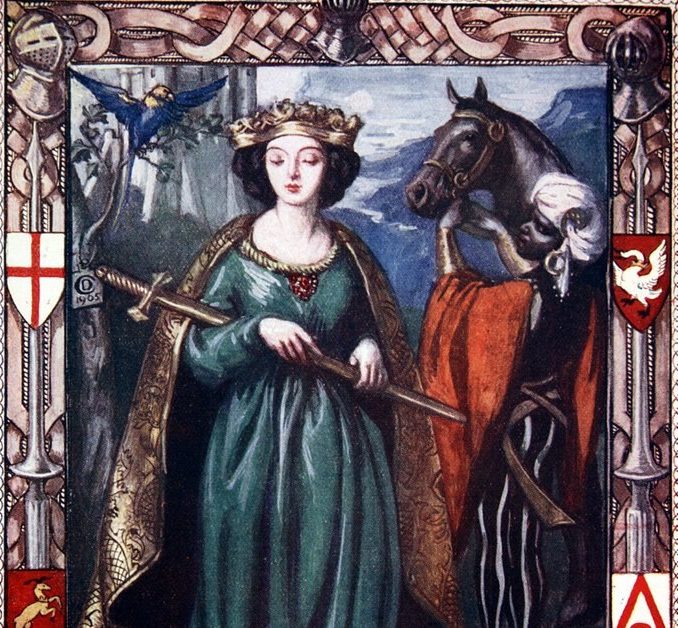
Women with power do not have to consort with the devil in order to obtain positions of authority. That should be a given, but according to some retellings of Arthurian legend, that simply can’t be the case. For instance: Morgan le Fay. Le Fay is either the most nefarious character in Arthurian legend, or she is a simple heroine maligned by fragile beliefs of patriarchal dominance. What is more, by analyzing Morgan le Fay’s character, readers can understand her relation to medieval society as a healer and harbinger of evil. Additionally, readers can understand how Morgan le Fay’s character shows that women were maligned throughout history regardless of their deeds.
A History of Morgan le Fay
Origins
Morgan le Fays’ appearances through history are just as enigmatic as the character itself. In one way, she has ties to Morrigan from Irish mythology and “the mari-morgans of Breton folklore.” As stated by Jessica Hines in “The Literary History of Morgan le Fay,” her relationship to the “divine mother goddess of ancient Gaul” Modron.
Perhaps the first literary appearance of Morgan le Fay occurred in Vita Merlini by Geoffrey of Monmouth in 1150. In this incarnation, le Fay had both shape changing and healing powers, aiding King Arthur after the enemy wounded him. In 1165, she would appear in Erec by Chretien de Troyes as Arthur’s sister. Her appearance changed somewhat in later years as she reflects a hostile villain against the king and queen. No doubt, le Fay’s transmogrification came about with changing attitudes to supernatural powers outside the church. It also changed due to attitudes toward a woman’s place in medieval society.
Connection to Witches and Witchcraft
Morgan le Fay’s history inevitability coincides with the history of witches and witchcraft. Her symbology as a powerful woman of nature undoubtedly lent itself to this image. By appearing as a powerful female with magical powers of healing and nature, her visage is that of one that stands as a contrast to King Arthur in Arthurian legend. In fact, through her embrace of naturalistic powers and healing abilities, she plays the role of tertiary practitioner.
At the height of witchcraft trials and wrongful executions (1500-1660), witch hunters burned (or hanged) innocent women for many reasons. This was during what was called “The Great Hunt.” Witch hunters accused upwards of 80,000 people and they saw to the murder of at least half of them. Consorting with the devil was a major cause of concern for many societies and maintaining the status quo was likewise important. Thus, accusations of deviltry in communities carried with it grave promises and prompted factually-dubious investigations. Yet, accusations were time-consuming and expensive, so not every accusation went to court. But, the rumors of witchcraft certainly existed which was damning enough for the social structure of a village.
Nevertheless, comparing Morgan le Fay in literature to witches, we find parallels to other women of lore and history.
Joan of Ark being one of them.
Witches of History
Joan of Ark and Anne Boleyn
National Geographic states that St. Michael convinced Joan of Ark, a medieval peasant, to fight against the English for the French. In battle, “she helped liberate the city of Orleans, invigorating the French troops’ morale.” However, after the English took her hostage, they burned her at the stake in 1431 for witchcraft.
As some sources stated of accusations, “maleficium” or sorcery, “prompted a wide array of suspicions.” Accusations typically included dying or diseased livestock, blighted crops, aggressive storm, feuds, rivalries, or something political in nature. What is more, Anne Boleyn, the unfortunate wife of Henry VIII, could not provide him with a male child. So, the court found her guilty of “adultery and treason,” and the king saw her beheaded. Later, accused of “being an 11-fingered witch.”
Link to Morgan le Fay
What these women have in common with Morgan le Fay is her power and her place in society. As Mark Twain writes derisively of feudal society and its related ills to the Gilded Age, we also find his wit in comparing le Fay to what used to be sorceresses in the 1500s and 1600s–witches. She is cunning, evil, shrewd, and quick to murder. And she focuses on torture as a means of extracting crucial evidence. When Morgan le Fay needed to become a frontline character in Arthurian legends, she became more malicious, violent, and vengeful. Those practicing witchcraft, too, went from healers to vile vagrants and connivers.
Witches as Devil-Worshipping Healers
Witches as healers predate the long-standing synonymy of witches and the devil–even though modern interpretations are far more feminist and favorable to witchcraft as empowerment. Then, their reputations became blackened by society when it was necessary. Perhaps, the spread of male-dominated religions ruled out “female deities” who had long “Trained in the sacred arts” and “became known as wise women.”
The transformation to devil-worshipper happened to real women just as Morgan le Fay’s transformation happened ot her fictionalized self.
“Centuries later, this fear of witches spread to Europe … when the plauge decimated Europe by killing one in three people … Amid the panic, many attributed their misfortune to the Devil himself–and his suposed worshippers.”
Of course, when hysteria takes off (like The Dancing Plague of 1518 [Choreomania]) it is impossible to stop and the stories keep building, from allegations of late-night rituals, to sacrificing infants, to naked dancing and sexual promiscuity. As it stands, any person with authority would look at torturing and murdering the innocent as the work of a sorceress or witch as well.
Traditional Views of Morgan le Fay
With many interpretations, Morgan le Fay comes off as evil in comparison to her brother King Arthur, and often is the cause of his undoing, as she mothers their incest-child, Mordred. However, in earlier texts, Morgan is actually a helper and healer of Arthur in Avalon (and in one account the ruler of Avalon), where she holds the house and tends to her brother. For instance, Le Fay’s appearance in Monmouth’s Vita Merlini (1148) is as a healer and helper to Arthur.
Later writings, such as the Vulgate Cycle (1215-1235) characterizes her as a malevolent force capable of great black magic which both harms people and hides her true age.
In Morgan le Fay: Origins and Evolution, researcher Andrea Whyland writes that Morgan’s change in the Vulgate Cycle shows that she is no longer a background player, but an active participant of the story. She states: “Morgan now lives in a castle, instead of the Otherworld of Avalon. Her magical powers suddenly became tools used for evil or manipulative purposes. This stands opposed to her history healing which is seen in earlier works. From this point forward, Morgan also plays more of an integral role in the sequence of events.”
Additionally, Morgan becomes a sexual being, attempting to seduce and capture Lancelot on multiple occasions. Her sexuality and penchant for magic aligns her with a certain amount of “witchiness.” This extends beyond the early cycles she appears in and into the 1600s. At this time, where women with power were viewed as evil, harassing hags. As such, in later writings (“Suite du Merlin” and “Sir Gawain and the Green Knight”), Morgan conspires against the heroes from Merlin to Arthur to exact revenge for love lost and to shame the entire Round Table.
Appearance in Popular Culture
In Mark Twain’s A Connecticut Yankee in King Arthur’s Court, Morgan le Fay is a variety of things: she is smart, she is a talker, she is interesting, and she is charismatic.
“She caused us to be seated,” states Hank Morgan, the protagonist, “and then she began, with all manner of pretty graces and graciousnesses, to ask me questions. Dear me, it was like a bird or a flute, or something, talking.” (Twain).
However her reputation preceeds her.
“… for I knew Mrs. le Fay by reputation, and was not expecting anything pleasant,” Hank states. “She was held in awe by the whole realm, for she had made everybody believe she was a great sorceress. All her ways were wicked, all her instincts devilish. she was loaded to the eylids with cold malice.”
And it is shortly after her kind introduction that she reveals herself, her true self, by stabbing a man with a dagger who dared to accidentally touch her. Her duality is almost Elizabeth Bathory-levels of wickedness. A ruler with literal skeletons in her closet.
Conclusion
Le Fay has endured a history of change and manipulation. However, there is one thing that has remained consistent–the spirit of her character as feminine power. Granted, often that power is perceived as evil or overbearing. Yet, by looking at her ability as a sorceress and a healer, readers find a character rife in autonomy and agency. These two qualities are important. The society contemporary to her interpretation may perceive that as evil or untoward, but from modern perspectives, Le Fay has proven resilient and capable of standing up to male-dominated legends of yore.
Leave a Reply