Magic is a wonderful element in fiction. It appears from wizards’ hands and from the Emerald City itself. There are also a great deal of regrettable actions in fiction, that lead characters to sin and vice. Yet, sometimes magic appears in tales of woe and regret. In “The Selfish Giant,” by Oscar Wilde, a magical garden takes center stage, as well as religious allegory and sorrow.
Summary of “The Selfish Giant”
The Angry Giant
Wilde’s “The Selfish Giant” tells the story of a giant who runs a beautiful garden. The beauty of this garden is truly magical indeed, and it has caught the attention of some local children. As rambunctious youths, they want to spend their days playing among the beautiful flowers.
Wilde writes that, “It was a large lovely garden, with soft green grass,” and “there over the grass stood beautiful flowers like stars, and there were twelve peach-trees that in the spring-time broke out into delicate blossoms of pink and pearl, and in the autumn bore rich fruit.” These pleasantries are enticing to children as it gives them a place to run and play. A place to be free.
The giant, an unhappy lout, catches the children playing reproaches them, sending them from his glorious garden. Driven off, the children find that they have few places to play and yearn to return to the garden. The giant, meanwhile, places a sign board up telling the children to “keep out!” The seasons take note of the giant’s actions. As punishment for this, the seasons decide not to change in the garden, and the birds do not sing either. A flower even pokes its head out, “but when it saw the notice-board it was so sorry for the children that it slipped back into the ground again, and went off to sleep” (Wilde). The seasons, meanwhile, had a field day.
Wilde writes: “The Snow covered up the grass with her great white cloak, and the Frost painted all the trees silver. Then they invited the North Wind to stay with them, and he came. He was wrapped in furs, and he roared all day about the garden, and blew the chimney-pots down.”
A Changing Heart
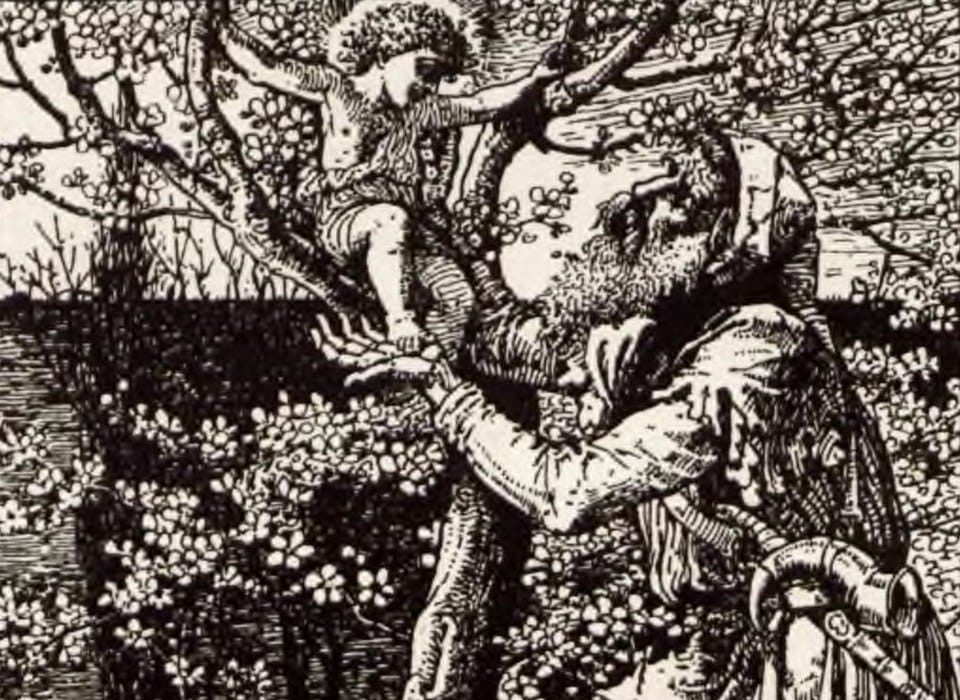
After a long time alone and without the spring, the giant wakes one morning and hears singing coming from the garden. He investigates and finds children in the playing. Overjoyed at their return, he then sees a small boy—much too small—trying to climb into the trees like the rest. This “melted” the giant’s heart and he went to help the child, which he does by setting him in the tree like the rest. With this action, the giant gave the garden to the children, having admitted to being selfish, and knocked down the wall he created to keep them out.
At the end of his life, the giant sees the little boy once more. However, now the boy tells him that he has come to take him to “Paradise” as the giant had shared his garden with the children.
Analysis of “The Selfish Giant”
This story is about magic in multiple ways—mostly love and redemption. The love of the giant proved a magical resource. Even though he was selfish, he was able to see through his own cruelty. He eventually becomes a decent person to the children (and steward of the garden). Additionally, through his redemption, the giant became selfless and caring, which benefitted more than himself.
Furthermore, we have religious allegory in this story, which often appears in fantasy fiction. The garden in which the children play is similar to Eden. The giant eventually shares this garden, and through magical/religious means, he is rewarded with paradise. This is afforded to him through the Christ-like child who takes him there.
At the end of the story, Wilde tells us that, “when the children ran in (the garden) that afternoon, they found the Giant lying dead under the tree, all covered with white blossoms.” White blossoms, while beautiful, also symbolize purity and innocence. Both of these characteristics the giant has regained through charitable spirit.
Conclusion
In “The Selfish Giant” by Oscar Wilde, the author tells tale of love, regret, and a changing heart. In a way, it’s Dickensian in scope. The scowling old miser learns his lesson, after all. By looking at this text and understanding both its religious allegory and allusions, the reader makes better sense of a world fraught with the haves and the have nots. Open your heart, the story tells us, and Paradise is yours.




Leave a comment