A Look at “Memorials” by Emily Dickinson

Life and death are universal themes for a reason. All people experience them in a variety of ways. Death invades our solitude. Life can bring us out of the depths. In “Memorials” by Emily Dickinson, remembering somebody after they are gone is a complex notion. In just five quatrains, her poem discusses the deceased through objects they left behind.

Analysis of “Memorials” by Emily Dickinson

In “Memorials,” Dickinson writes, “Death sets a thing significant / The eye had hurried by, / Except a perished creature /Entreat us tenderly.” She begins her poem this way and in so doing, reflects death as an object that becomes relevant to our understanding of mortality. What catches our eye reminds us of those we lost. Sometimes the object, much like a “thimble” or a book with annotations can remind us of a great deal from somebody’s life.

Furthermore, Emily Dickinson writes in “Memorials” that “The thimble weighed too heavy, / The stitches stopped themselves, / And then ‘t was put among the dust / Upon the closet shelves.” Here we again see how the thimble reminds us of something else entirely, and it carries with it a weight of memory. The light of memory lingers for the reader because they also see the hands that held the object. They are the hands of somebody who has died.

In the last stanza of the poem, Dickinson states, “Now, when I read, I read not, / For interrupting tears, / Obliterate the etchings / Too costly.” At this point, we know the emotional cost of finding such a relic. We tie these feelings to the object itself so that we can feel a moment of life a little longer. Maybe we are trying to remember a parent, or a grandparent; either way, the relic takes us back to their own memory and allows us pain and sadness, and catharsis.

Conclusion

Dickinson, who has written much about death, tells the reader that there is no immortality in the literal sense. In the same respect, we may live a long time, but we will always lose people in our lives. It’s the little things that remind us of that loss. Dickinson tells us that it could be a picture, an article of clothing, or even just a thimble. It’s these small gestures that tug at us emotionally, but they also remind us of the love we had and the love that still exists in our hearts.

The Violent Crimes of the Werewolf of Bedburg

In the annals of lycanthropy, there are many stories of violent crime against humans from one with wolf-like attributes. The story of Peter Stumpp is one such story. Historians and speculators have immortalized his crimes in the history books, as judiciaries of the era accused Stumpp of lycanthropy. Not exactly a modern crime. But just like the infamy of the Witches of Salem, today the public knows Stumpp as the Werewolf of Bedburg. Unfortunately, his crimes go beyond simple murders by moonlight.

The Medieval Setting

When the world was in the throes of medieval tyranny–aka the Dark Ages–there were many atrocities that assailed humanity. War, famine, disease, and torture were all realities of life. To be a serf or a laborer, meant an exhausting existence of pitiless cumber under the barons and lords of feudal society. 

These lowly workers also dealt with the inexplicable. 

Take for instance, the Dancing Plague of 1518, in which citizens of Strasbourg, France, danced uncontrollably until they grew fatigued or died. A strange circumstance, but mass hysteria has a way of controlling those of limited education and intelligence. In the case of the Werewolf of Bedburg, multiple killings drove the community into a frenzy of fear and vengeance. Yet, the enemy was extremely stealthy, and as legend states–had the ability to shapechange.

Background of Violence

A werewolf, simply put, is “a person transformed into a wolf or capable of assuming a wolf’s form.” These fairy tale creatures began to take a truer form in Medieval society due to exceptionally gruesome murders and killings in rural communities. While sources typically point to undiagnosed psychological issues and hysteria, for serfs and laborers, these hounds from hell were very real.

In Europe between the years of 1564 and 1589, cattle mutilations and slayings occurred in and around the small village of Bedburg in Germany. The villagers first discovered desiccated cattle, which something had violently slaughtered and eaten. Later, the bodies of local townsfolk began to appear, bloodied and stripped of life and dignity. Of course, the thought of a frenzied wolf-man committing these atrocities did not seem likely. Nevertheless, for nearly a decade, the killer stalked the wilds around Bedburg, hunting for hapless victims that included men, women, and children. 

The Werewolf Strikes

Nobody in the village knew who to suspect, but as with most undetected killers, they are typically the ones we least suspect. Peter Stumpp (or Stubbe, or Stumpe, or Stumpf), lived near Cologne, Germany, in the 1500s. While he was a farmer in his work life, he also spent his private time looking for victims in the community. In a similar vein to Sawney Bean in Scotland, Stumpp found the weakest in society, and preyed up on them.

“Peter started by murdering, in wolf-shape, anyone who displeased him, plus their relatives,” states Nancy Garden in Werewolves. Accordingly, he hunted the helpless because they were easy to overpower. Garden adds, “Often he went through the streets, well-dressed and polite, even saying hello to friends and relatives of people he had murdered. Then, in wolf-shape, he would kill their lambs and goats, and their daughters, too, when he had the chance.” 

After years of murders and attempts to capture the killer, the locals finally stopped Stumpp. Unfortunately, the death toll in Bedburg had become too much, with the discovery of human limbs (arms and legs) in the surrounding fields. With fervent veracity, a group of locals and hunting dogs captured Stumpp after cornering him in the forest. As if to spite the hotly sought after murderer, the authorities decided to torture the confession out of Stumpp.

The Devil’s Belt

Under pain of torture–a breaking wheel (wooden rack)–Stumpp admitted to consorting with the Devil. He claimed to have worn a belt that allowed him to turn into a wolf-like entity that was voraciously hungry for meat and flesh. In this form, Stumpp allegedly killed man, animal, and his own kin (eating his own son’s brains). The courts convicted Stumpp of killing 16 people, including 13 children. The judges sentenced Stumpp to death, and executioners tested his mortality on Oct. 31, 1589. 

As some sources state “… Peter Stubbe was tied to a wheel and flayed, broken, decapitated, and burned at the stake, at each stage the tools used by his executioner invoked aspects of the crimes they were meant to punish, ‘thereby mapping the misdeeds on to the body of the criminal’” (Brown). In a likewise grisly manner, other sources point out that torturers ripped Stumpp’s skin and flesh with “hot pincers,” and his arms and legs were “broken with the blunt side of an axe before his left hand was cut off.” Stump, a violent murderer, met a fate just as grisly as the ones he

Conclusion

The story of Peter Stumpe, the Werewolf of Bedburg, is a violent one. From his own murders of men, women, and children, to his harrowing execution, he lived a life of misery. Similarly, those that fell under his animalistic insanity were also grimly disposed of by his violence. Stumpe’s admission in court is still analyzed to this day. It should be noted that his story reminds us that insanity was left undiagnosed in Medieval times, and the thought of werewolves explained excessive violence when saner explanations were left unfound. 

Works Cited

Neumann, Sean. “His Son and Other Murders. Was He Really a Killer, or a Victim of Mass Hysteria?” People, 1 Feb. 2025, Web. 

Walter, Katie L. “Review of Flaying in the Pre-Modern World: Practice and Representation, by Larissa Tracy.” History, vol. 104, no. 360, Apr. 2019, pp. 331-334.

Exploring ‘The Mysteries of Harris Burdick’ by Chris Van Allsburg

I can vividly recall my first encounter with The Mysteries of Harris Burdick in my 5th-grade classroom. I was seated near the front, and my teacher presented each page of the book on a slideshow (probably an old wheeled-projector, given it was the 90s). As each image flashed by, my curiosity was piqued; it was all so strange.

The pictures, though numerous, summarily depicted something fantastical: a house shooting into the sky, children on a railroad trolley bound for a distant, otherworldly land. In one image, a child slept over a book, now overrun with vines. The caption read: He had warned her about the book. Now it was too late. The only other time I recall being equally perplexed involved learning about Roanoke Island in the same 5th-grade classroom. In a similar vein, Burdick’s illustrations match the baffling nature of “Croatoan.”

However, The Mysteries of Harris Burdick ignited the narrative writer in me at the time. Our assignment, as given by the teacher, was to choose an image and craft a story around it. Naturally, one image interested me the most. It is the image of an older man with glasses, hoisting a chair high above his head. A lump beneath his carpet menaces him in a dreadful manner.

Underneath the picture, the caption read: Two weeks passed and it happened again.

In this brief writing, we delve into the 1984 picture book The Mysteries of Harris Burdick by Chris Van Allsburg, exploring the author, its fictional background, and its textual and visual significance.

Who is Chris Van Allsburg?

Published in the mid-80s, Chris Van Allsburg, a celebrated writer and illustrator, created The Mysteries of Harris Burdick. Allsburg was born on June 18, 1949, in Grand Rapids, MI. Allsburg attended the University of Michigan and the Rhode Island School of Design.

His inaugural work, The Garden of Abdul Gasazi, debuted in 1979. He penned numerous more tales for children, including Bad Day at the Riverbend in 1995 and Probuditi! in 2006. Three of his books—Jumanji, The Polar Express, and Zathura—were adapted into popular films by film studios.

The Real Mystery of Harris Burdick

Returning to The Mysteries of Harris Burdick, Allsburg conceived the fictional character of the titular author, who vanished after creating and illustrating the book of pictures himself. While seemingly an intentional (and enigmatic) creation, much like William Goldsmith’s meta-narrative introduction in The Princess Bride and Stephen King’s pseudonym Richard Bachman, the character truly comes alive in the book’s introduction, also penned by Allsburg.

In the 1995 introduction, Allsburg recounts that a man named Peter Wenders, a children’s book publisher, arranged to meet Harris Burdick to discuss the illustrated book that would become The Mysteries of Harris Burdick. According to the introduction’s lore, Burdick brought only the images, which captivated Wenders. The publisher agreed to read Burdick’s companion stories the next day.

That was the last time Wenders saw Burdick.

“Harris Burdick was never heard from again,” writes Allsburg. “Over the years, Wenders tried to find out who Burdick was and what had happened to him, but he discovered nothing. To this day, Harris Burdick remains a complete mystery.”

Later, as per the introduction, a literary antiquarian discovered another drawing (likely by Burdick) behind the glass of a mirror that had cracked in his shop. The picture bore “a title and caption written in the margin at the bottom”—the unmistakable signature of Harris Burdick. However, his whereabouts remain unknown, at least according to lore (Allsburg).

Why Harris Burdick Matters

Burdick’s Impact on Writers

Burdick’s pictures entranced not just my own 5th-grade mind, but also the minds of writers everywhere. As they encountered the book, whether through assignment, discovery, or presentation, they found themselves captivated by what lay between its covers. It’s a beautifully manufactured book, teeming with inspiration for writers within. The images are profoundly captivating, each a masterstroke of visual stimulation.

Allsburg attests that he has “received hundreds of Burdick stories written by children and adults” over the years, a tribute to how vital Burdick’s work has been as a wellspring of motivation for writers.

Lemony Snicket, the fictional author of A Series of Unfortunate Events, asserts in the foreword to The Chronicles of Harris Burdick: Fourteen Amazing Authors Tell the Tales, that Harris Burdick’s true disappearance wasn’t one for the late-night crime shows, but one that empowered writers; it was a magic trick that held significance for every writer who ever grappled for inspiration.

Snicket suggests: “Mr. Burdick might have dispensed his stories, over many years, to his comrades in literature. Perhaps he bestowed them as gifts in appreciation of their hospitality. Perhaps he concealed them in their guest rooms, hoping they would never be found. In any case, it was always my hope that the rest of Mr. Burdick’s work would surface, even if the mysteries of Mr. Burdick—who by now is either very old, quite dead, or both—remained unsolved.”

Personal (Transcendental) Impact

Subconsciously, this book frequently crosses my mind, along with the story I penned in 5th grade featuring a man assaulting the carpet with a chair. In fact, I fancied myself the next great horror writer in America (even in 5th grade), but I ended up crafting a tale so horrifyingly dumb that it elicited uproarious laughter from my class—and even the teacher couldn’t contain herself. I remember her pulling her glasses off as streams of tears raced down her cheeks. Nevertheless, everybody seemed to appreciate my venture into horrific narrative, all thanks to the inspiration drawn from The Mysteries of Harris Burdick. Perhaps, you appreciated your own jaunts into the strangely picturesque world of Burdick’s images as well.

If you haven’t yet delved into The Mysteries of Harris Burdick, I wholeheartedly recommend it. Likewise, please share which image you find most intriguing as a source of inspiration in the comments!

Works Cited

Allsburg, Chris V. The Mysteries of Harris Burdick. HarperCollins Publishers. 1996.

Allsburg, Chris V. The Chronicles of Harris Burdick: Fourteen Amazing Authors Tell the Tales. HarperCollins Publisher, 2011.

“Chris Van Allsburg.” All American Speakers. Web. https://www.allamericanspeakers.com/speakers/429875/Chris-Van-Allsburg

An Analysis of “The Masque of the Red Death” by Edgar Allan Poe

“And Darkness and Decay and the Red Death held illimitable dominion over all.”— Edgar Allan Poe | The Masque of the Red Death

To shield oneself from death is to hide from the inevitable. But death can will find you; after all, it finds all living beings at one point or another. Now, whether you make good of that surety, or try to lock yourself in a palace of ignorance is your choice I suppose. But remember: Death will always find you! In Edgar Allan Poe‘s “The Masque of the Read Death,” the protagonist find themselves confronted with death as it seeps through the fortress walls and into a sightly party.

Summary

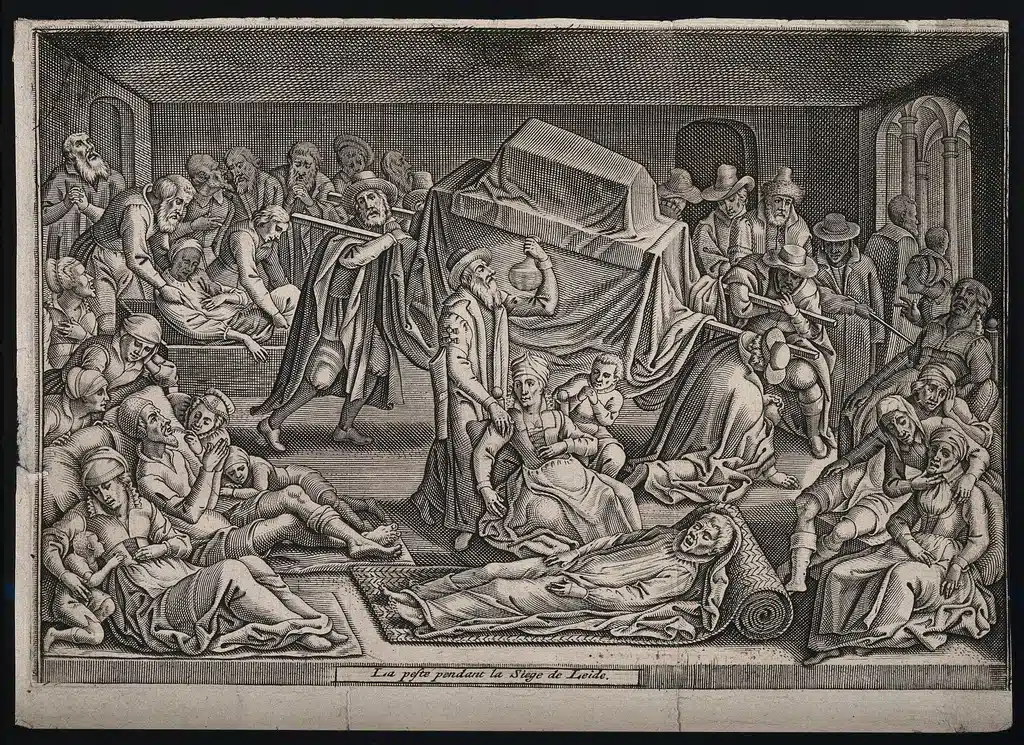
“The Masque of the Red Death” tells the tale of an upper class party that has quarantined itself from the rest of society. A plague has swept the city (more than likely the bubonic plague). Prince Prospero, who is in charge of this party, has gone through great lengths of seclusion to keep his cohorts safe from this “Red Death.”

Poe writes of Prospero: “But the Prince Prospero was happy and dauntless and sagacious. When his dominions were half depopulated, he summoned to his presence a thousand hale and light-hearted friends from among the knights and dames of his court, and with these retired to the deep seclusion of one of his castellated abbeys” (Poe). The crowd is enthralled with the lavish masquerade party, Poe tells us. Yet, while they are gleefully enjoying their party, a masked figure arrives and begins moving toward a room that is otherwise off-limits to the guests. He dresses in a crimson costume and moves through the crowds unnaffected.

As Prospero follows the stranger, he becomes frightened by the figure’s ghostly movement. So, Prospero decides to engage this foreboding character. However, he gets more than he bargained. As a final act, the figure reveals nothing underneath its robe, and the sight of this invisible assailant kills Prospero outright.

Analysis

The Title

It is worthwhile to note that the word “masque,” that Poe used in the title, has a double meaning. The strange figure who appears is the “masque of the Red Death.” Meanwhile, other meanings stem from court entertainment in the 16th and 17th centuries. The masque itself was a form of festival, pageant, or play performed by “actors wearing masks.”

As stated by Britannica, the masque featured “costumed and masked persons” who “arrived at a social gathering to dance and talk with guests. The masque could both be a simple parade or a lavish spectacle and event.

Story Elements

Poe’s “Masque of the Red Death,” though portentous in tone, has lovely atmosphere and a frightful villain. The idea of hosting a gallant party while a plague sweeps across the country has a certain charm. Perhaps one that hits too close to home. In modern terms, the Red Death could certainly symbolize Covid. Yet, the fear of sickness has always been a pervasive fear in society. The quarantine put into affect in various countries definitely mirrors Prince Prospero’s holdout in the castle.

However, we also know the vile nature of hiding from death if only to save yourself from its clutches for a short while longer. Of course, Prospero learns this all too late when his fate is sealed at the finale. The innate flaws in his character (being narcissistic and wealthy) ultimately bring his life to a close. The story itself is about running from death–thematically–as a means to avoid its touch; but, as with most Poe stories, the protagonist suffers a horrible fate due to their own malicious intent.

The story ends beautifully. Poe writes: “He had come like a thief in the night … one by one dropped the revelers in the blood-bedewed halls of their revel, and died each in the despairing posture of his fall. And the life of the ebony clock went out with that of the last of the gay … the flames of the tripods expired. And Darkness and Decay and the Red Death held illimitable dominion over all” (Poe).

The characters had reveled in their security, high above the uncultured swine, and they fell fast and hard just as the rest. Death cannot be escaped whether you live in desperate, plague-laden penury, or you are in lavish luxury. It will find you, and it will claim you in the end.

Works Cited

Poe, Edgar Allan. “The Masque of the Red Death.” The Complete Tales and Poems of Edgar Allan Poe, edited by Arthur Hobson Quinn, Anchor Books, 1975, pp. 345-352.