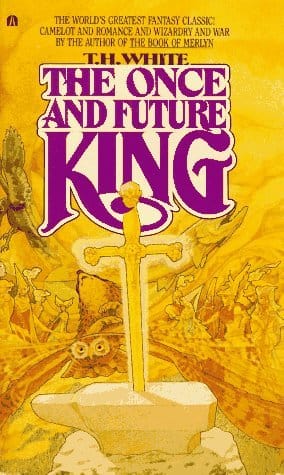
If you’ve read A Connecticut Yankee in King Arthur’s Court by Mark Twain, you probably look at Arthurian Legend a little differently. Knights aren’t the noble stalwarts touted by history, but bloodthirsty marauders. Merlin is a conman, and Mordred is a monster. Yet, the original tales still exist, and there is a purity in these legends. For example, The Once and Future King (1958) by T.H. White gives readers a traditional telling of Arthurian legend that is simply a must read.
Summary
The novel is broken up into four parts: The Sword in the Stone (1938), The Queen of Air and Darkness (1939), The Ill-Made Knight (1940), and The Candle in the Wind (1958). The novelette collection is heavily inspired by Le Morte Darthur by Sir Thomas Malory. The story details Arthur’s beginnings to his end, covering his tutelage, reign, and downfall. The novel catalogues these stories, relaying their happenings in a traditional sense.
Book blurb
From the book:
“Once upon a time, a young boy called “Wart” was tutored by a magician named Merlyn in preparation for a future he couldn’t possibly imagine. A future in which he would ally himself with the greatest knights, love a legendary queen and unite a country dedicated to chivalrous values. A future that would see him crowned and known for all time as Arthur, King of the Britons.
“During Arthur’s reign, the kingdom of Camelot was founded to cast enlightenment on the Dark Ages, while the knights of the Round Table embarked on many a noble quest. But Merlyn foresaw the treachery that awaited his liege: the forbidden love between Queen Guenever and Lancelot, the wicked plots of Arthur’s half-sister Morgause and the hatred she fostered in Mordred that would bring an end to the king’s dreams for Britain—and to the king himself.”
Critical Response
T.H. White’s The Once and Future King has a 4.07 on Goodreads.
Five-star reviews reference the “classic” nature of the book and the “great characters” present between the covers. One reviewer writes that it is the “pinnacle of all fantasy,” which speaks to its stature in the annals of literature. Meanwhile, one-star reviews also referenced its “pinnacle” nature but as a detractor as it is far more “boring” than “crucial.” Moreover, other reviewers reference other interpretations as superior including Sir Thomas Mallory’s version.
Of course, separating these two ideas is essential, especially with a book that has an average of 4 out of 5 stars, as they offers some insight into its clout as a literary staple.
Impressions
One of my earliest memories of film is The Sword in the Stone (1963) from Disney. This movie is largely taken from The Once and Future King’s first section, The Sword and the Stone. With that said, White’s book is a classic without stretching credulity. Though it is a longer work, it spells out the Arthurian legend in detail. For a reader, this is like watching a familiar movie–you can follow the story beats easily. There is satisfaction in this experience.
Furthermore, I think one of the strengths of the novel that it was written by T.H. White. White uses solid description and verbiage to convey a fantastical sentiment. His language is simple and direct. This often gets lost in Arthurian legend.
As White states in the book: “What did happen was that Merlyn, who had been saying the final spells under his breath, suddenly turned himself into a condor, leaving the Wart standing on tiptoe unchanged.” White does not play in ambiguity. He writes straightforward syntax that conveys the story plainly. Though it’s an old novel, it is somewhat refreshing to read White’s style.




Leave a comment