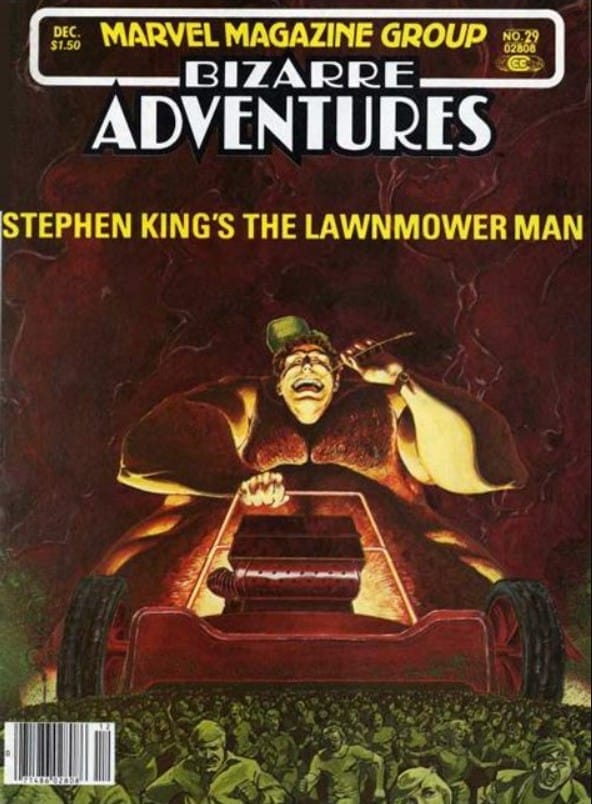
Stephen King is a prolific author who has published a staggering amount of successful writing. This is not an issue that plagues too many authors. However, his success brings other issues. Namely, a lot of his work goes to the big screen, and a lot of his work gets poorly adapted. Often, the story that is presented in cinema looks nothing like the book it came from. In this post, we examine the strange tale of “The Lawnmower Man” adaptation lawsuit. There are no signs of a short story here; only a movie that wanted to use King’s name to draw in audiences.
The Short Story: “The Lawnmower Man”
Let us begin with the source material:
The short story “The Lawnmower Man” was first published in Cavalier in 1975. Later, it appeared in Stephen King’s dynamite short story collection Night Shift. It tells the story of Harold Parkette, a middle-aged man who hires a new company to mow his lawn. After the new lawnmower man arrives, he upsets Harold with some of his innovations in lawn service. These innovations include eating grass, paying homage to the Greek god of the wild Pan, and a bunch of other weird stuff.
But the lawnmower man was the true obscenity.
The lawnmower man had removed his clothes–every stitch. They were folded neatly in the empty birdbath that was at the center of the back lawn. Naked and grass-stained, he was crawling along about five feet behind the mower, eating the cut grass. Green juice ran down his chin and dripped into his pendulous belly. And every time the lawnmower whirled around a corner, he rose and did an odd, skipping jump before prostrating himself again.”
After Harold sees this, he faints. When he wakes, the lawnmower man, still naked, explains that the Great God Pan is the true innovator (“God bless the grass.”) by killing two birds with one stone, by making money for “other operations.” Harold, terrified, retreats inside and calls the police. During the fumbling conversation, the lawnmower man bursts in with his mower and advances on Harold.
“Now if you was just to show me where you keep your sharpest butcher knife, we could get this sacrifice business out of the way real painless …”
Harold is devoured by the lawnmower, and the detectives on the scene are unable to make heads or tales of his death.
The Film: The Lawnmower Man (1992)
The film was released in 1992 and is a science-fiction thriller directed by Brett Leonard. It tells the tale of Jobe Smith (Jeff Fahey), who is intellectually disabled, and Dr. Lawrence Angelo (Pierce Brosnan). Dr. Angelo wants to help Jobe by giving him a higher intelligence by using virtual reality. His experiments increases Jobe’s intelligence, but also fuels his lust for violence and ultimately his desire to dominate cyberspace. The movie was originally titled CyberGod, which is actually a great title and makes more sense than The Lawnmower Man.
The Adaptation Disconnect
Yet, the only similarity between the short story and the movie is that they both (at some point) feature a person and a lawnmower. Unfortunately, tenuous is the only word that accurately describes the relationship between the film and the King’s work.
Furthermore, it would seem that the adaptation part of turning “The Lawnmower Man” story into a film was the least of production’s concern. New Line Cinema, the studio in charge of releasing the film, and the director, Brett Leonard, featured nothing from the story outside of the few aforementioned elements. As such, a court found the company in the wrong for using King’s name.
As stated in an Entertainment Weekly article:
“In 1992, a New York court issued an injunction against New Line’s use of King’s name to sell the film. In a later settlement the studio also agreed to pay the writer $2.5 million in damages” (Davidson).
Yet, the saga did not end there, either. New Line Cinema still released the movie with King’s name on the packaging. King found this out by using “a team of private investigators.” As stated by writer David Rollinson in “The Lawnmower Man Redefines the Term ‘Loosely Adapted.’”:
“A judge slapped New Line Cinema with contempt of court, diverting all film profits from May of 1993 to King himself, as well as fines of $10,000 a day until the offending VHS covers were changed. While no final sum has been disclosed, King has stated he was very happy with the outcome” (Rollins).
The company seemed determined to keep Stephen King’s name on the packaging for marketing purposes. One might conclude that the quality of the film spoke to such ardent efforts.
Conclusion
There is a long history of studios taking advantage of writers and their works.
Consider the following list:
- Isaac Asimov’s novel I, Robot was turned into a shoddy 2004 mess with action galore.
- Eragon, an epic fantasy novel series with depth, was turned into cliche-extravaganza in 2006.
- The Giver by Louis Lowry was turned into a 2014 teen romance that undersold the complex of the original work.
Unfortunately, artists are treated unfairly when their works have been commodified to an unhealthy degree—such as most of Stephen King’s work. Nevertheless, these types of grievances can be expected when your name and content have been used on a Funko Pop figurine.
Then again, it is nice to see the artist can win out against the machine from time to time.




Leave a comment