“We all create stories to protect ourselves.”— Mark Z. Danielewski | House of Leaves
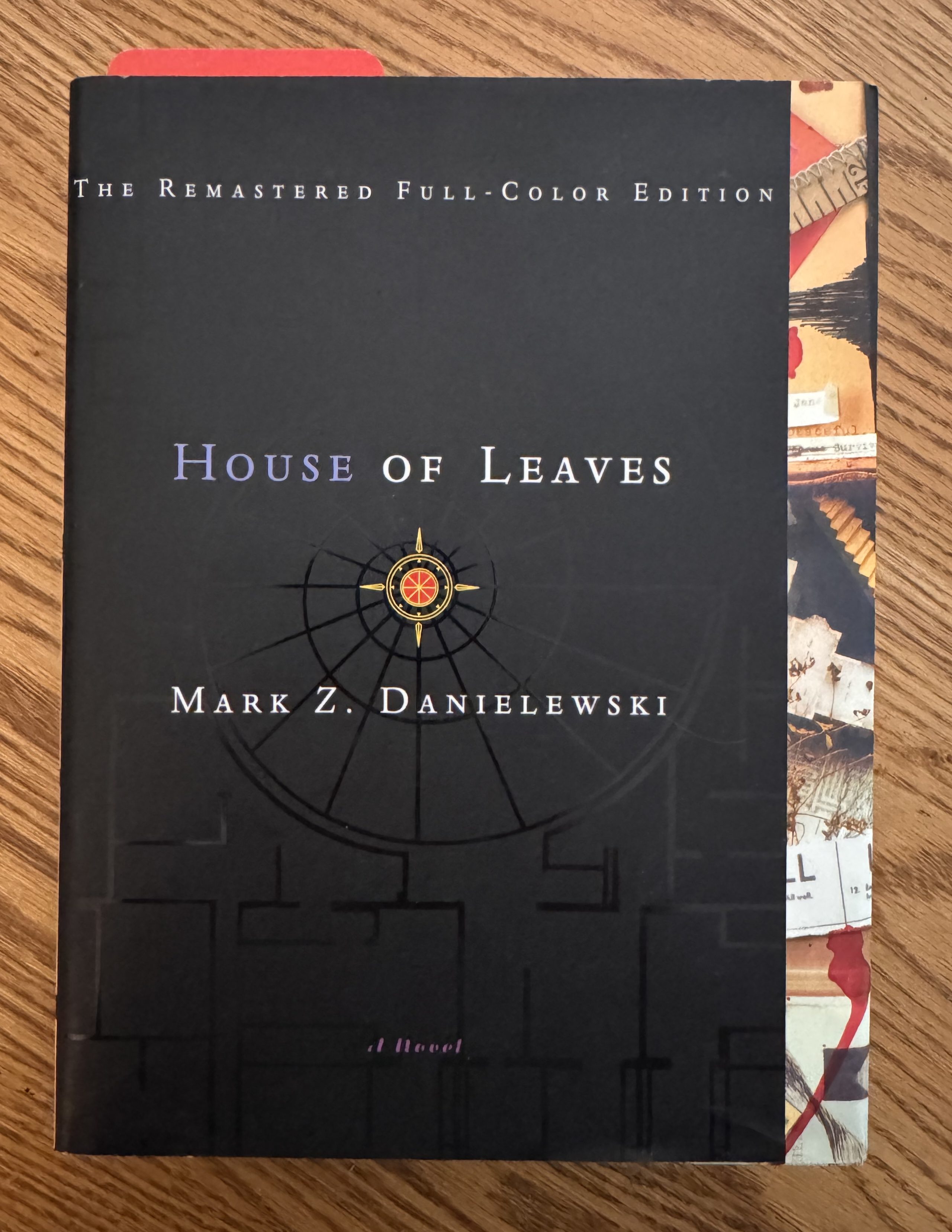
In House of Leaves by Mark Danielewski, a book that is a book is not a book at all. The story it tells is both captivating and alarming. In this way, the majesty of a book that is “not a book” is an enchanting thing to encounter. Yet, these types of books can be the exact catalyst for something more strange and frightening. Doubling down on this, what if the narrator(s) is completely unreliable? House of Leaves presents the reader with a horrible contrast between the real world and the unreal possibilities of the truth–whatever that may be in it true form.
Summarizing the Impossible House
House of Leaves by Mark Danielewski is a “found” novel by an author named Zampano. Meanwhile, Johnny Truant, who has discovered the book, offers his own edits on the text to post posthumously for Zampano. Truant comments on its authorship is footnotes for clarifications and translations. Meanwhile, other editors opine on the text and Truant’s own edits, providing a super-meta commentary.
Moreover, House of Leaves is also about a house that is “bigger on the inside” than it is on the outside. A family moves into the house and begins recording all the strange happenings inside the home. The film, and other relics about this house becomes a documentary called The Navidson Record. This collection of evidence falls into the annals of folklore and falls under the scrutiny of critical examination as either being real or a hoax.
As a result, Zampano’s book is an academic approach to the documentary film The Navidson Record. The book’s literary attempt at examining the documentary includes historical context. It also shows the relationship to the world in which it was created. However, Zampano analyzes it from a horror perspective in his attempt to explain the oddness of the house. Truant’s descent into analyzing Zampano’s work results in him dismissing the writer’s claims and sources. But, by the end, readers call his own reliability into question. It seems the House of Leaves is just as mysterious as the documentary reports themselves.
Book Blurb: House of Leaves
From the Book:
“A young family moves into a small home on Ash Tree Lane where they discover something is terribly wrong: their house is bigger on the inside than it is on the outside.Of course, neither Pulitzer Prize-winning photojournalist Will Navidson nor his companion Karen Green was prepared to face the consequences of that impossibility, until the day their two little children wandered off and their voices eerily began to return another story—of creature darkness, of an ever-growing abyss behind a closet door, and of that unholy growl which soon enough would tear through their walls and consume all their dreams.”
Critical Response
Reviews on the back of the book are as follows:
”Simultaneously reads like a thriller and like a strange, dreamlike excursion into the subconscious.” —Michiko Kakutani, The New York Times
“Thrillingly alive, sublimely creepy, distressingly scary, breathtakingly intelligent—it renders most other fiction meaningless.” —Bret Easton Ellis, bestselling author of American Psycho
“This demonically brilliant book is impossible to ignore.” —Jonathan Lethem, award-winning author of Motherless Brooklyn
Additionally, Good Reads has it listed as a 4.09 our of 5 stars.
Five-star reviewers state that “House of Leaves is not an easy book to read. Yet, readers believe it is an important read nonetheless. Another reviewer stated that the book is “a postmodernistic satire on the subject of epistemology.” That is to say, the novel connects sources and investigations into one book and calls into the question of reliability of sourcing in general.
Meanwhile, one-star reviews stated that the book made some readers feel” bored, and annoyed” and others found that “nothing seems to happen.” In addition to that, some readers felt that the book’s “overdone” narrative felt like a “dish served in a restaurant” that should be “sent back.”
Overall Impressions of House of Leaves
I heard of this House of Leaves by Mark Danielewski around the time I was finishing True Detective season one, as it seems to have quite a lot in common with weird fiction and The King in Yellow by Robert W. Chambers. These commonalities include the narrative choices themselves, such as what information the reader discovers where and when Moreover, the overall eeriness of the story is far to intriguing to not investigate. Even after the fact, the reader never gets to know everything about the story.
Danielewski’s House of Leaves is an interesting book if you are interested in the macabre. It is a multilayered story that asks readers to go beyond the regular idea of a narrative. In this way, engaging with the content more critically is important, perhaps even by close reading each page.
In another instance, I own a book–a sort of manipulative biography–about Stephen King that features inserts of faux-posters and edited pages from real books. They are duplicates and copies, but it is an excellent way to experience the history of an author and his contributions to horror literature.
Similarly, the nearly experiential engagement of House of Leaves will pull you right in, but with the right mindset, just like the house, it’s a lot smaller on the inside.
Leave a Reply