The loss of a loved one dominates many ghost stories that have been shared throughout history. In fact, even the Paulding Light‘s background is related to the loss of life. In this post, we will see familiar and unique qualities related to folklore in the Singing Sands of Bete Grise.
Background of the Singing Sands of Bete Grise
Site and History


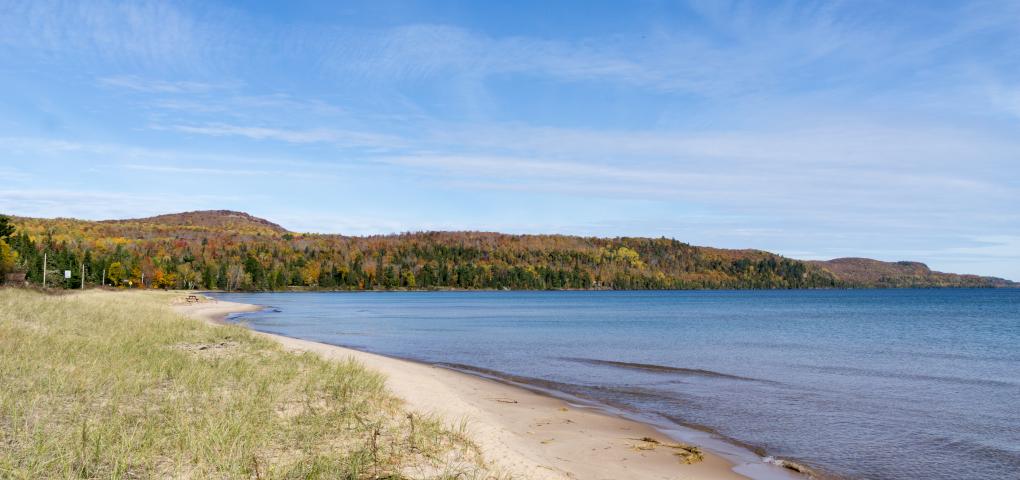
The site of the singing sands is on the south side of the Keweenaw Peninsula in the Upper Peninsula. The beach “sings” to visitors who stroll along the beach and interact with the sand itself. So the story goes, a Native American girl lost her lover when he disappeared on Lake Superior. To call for him, she spent her days singing in grief along the beach.
Moreover, the Detroit Free Press stated that the Singing Sands relate the story of a young Native American woman. As stated: “After her lover drowned in Lake Superior, she stood on the shores and sang in hopes he would find his way back to her.” Eventually, the woman “withered to dust herself.” Yet, her voice still sang “calling out to lead [her] lost lover back to her” (Martin).
The “Bete Grise” part is also a legend unto itself. It means “gray beast” in French, which Native Americans purportedly saw in the state’s infancy.
Beachhead Anomalies
Visitors can hear the singing when they “rub hard” on the sand. Likewise, when they “smack the sand” with their open palms, a similar sound occurs (Robinson). Additionally, rotating your palm on the sand creates a ringing sound much akin to a high singing voice. However, the truly unique quality of the sand is that it only “sings” on that particular beach. When removed from the lake shore, it no longer makes a sound.
Explanation of the Singing Sands
A Sandy Solution
The scientific explanation for this strange occurrence is quite natural. Researchers claim that the sand makes the musical sound due to “sand-grain size and humidity” (Bingham). In effect, the unique environment on the peninsula explains why the sands only resonate that noise in that spot. So scooping it up and taking it away deprives it of the ingredients needed to generate its music.
The Perfect Grain
Furthermore, Alexis Dahl states on her YouTube channel, to make “Singing Sand,” the sand should be particular. It should be spherical grains, uniform in size or 1/3 of a millimeter across, and can’t be “too wet” and “not too dense” (Dahl). Then, when you rub this perfect sand, the friction creates vibrations, which then creates the “squeaky” or singing noise.
Conclusion
The singing sands, much like the Paulding Light, has a sorrowful tale behind it meant to explain its strangeness. Remember, with folklore, the idea is to share stories that help us understand the world around us more clearly. That is to say, long before experiments and speculation found their way to these parts of the world, people had to explain why a beach might make an odd noise. Without the knowledge of sand-grain size and friction, a justification was necessary. Therefore, the tale of a grief-stricken woman singing out to her lover answered those questions when the advent of science was still a dream. However, now we know it has more to do with the unique environment of the beach. Nonetheless, the story of the beach is still engaging and effectively draws visitors to the area year after year.
Works Cited
Bingham, Emily. “25 Upper Peninsula marvels everyone should see.” MLive. Aug. 21st, 2016. Web. [link]
Dahl, Alexis. “Why Are Some Beaches Squeaky (The Legend of the Singing Sand) | Bete Grise, Michigan.” YouTube, uploaded by Alexis Dahl. May 28, 2021. Web. [link]
Martin, Kylie. “Michigan urban myths and legends: 7 stories to share around the campfire.” Detroit Free Press. Aug. 9, 2023. Web. [link]
Robinson, John. “Legend of the Bete Grise ‘Singing Sands’-Keweenaw Peninsula, Michigan.” 99wfmk. WFMK, Townsquare Media, Inc. Oct. 2, 2018. Web. [link]




Leave a Reply