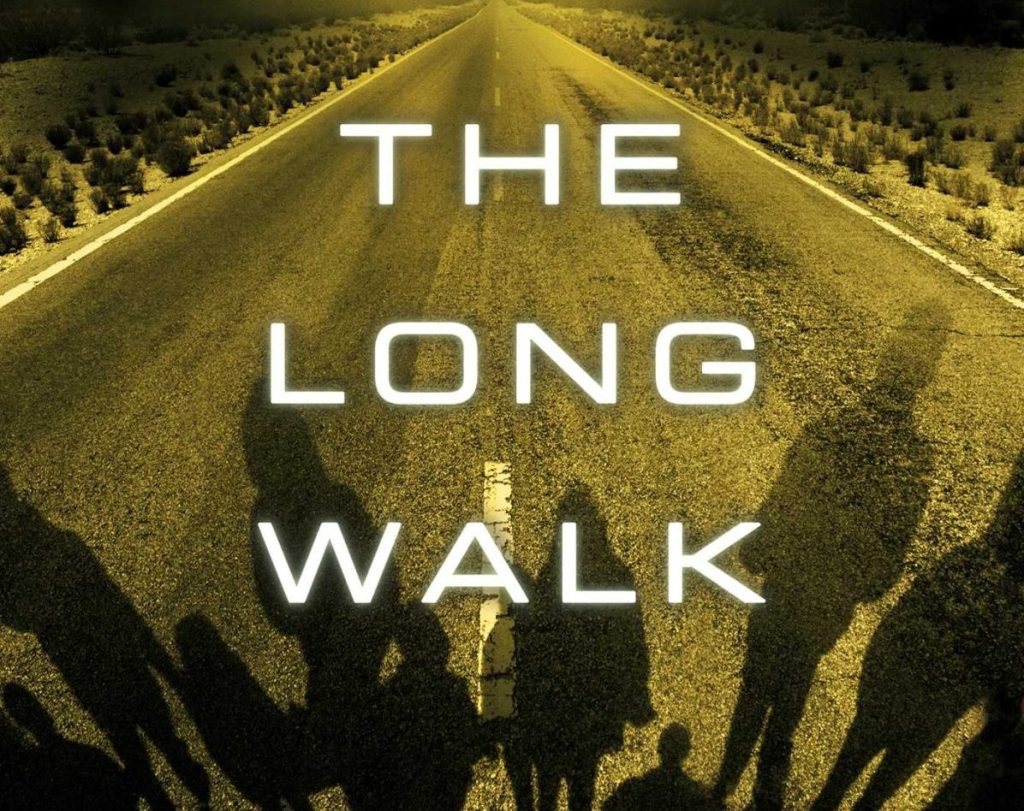
The thought of walking a 5k is miserable to some people, but walking endlessly until only one of you remain? Well, that would be a nightmare. However, what if your prize is anything that you choose? Money? Love? Richard Bachman (author Stephen King‘s famous alter-ego who died due to cancer of the pseudonym) executed this idea during his freshman year at the University of Maine in 1967. That story came out as Stephen King’s “The Long Walk.” It is also a story straight from King’s distinct Bachman-voice. These stories are a bit more violent, and a bit more pointed. Currently, the production company Lionsgate is producing a film directed by Francis Lawrence, which is due out Sept. 12, 2025. But what is this story about, and what does it say about who we are as a society?
Summary of Stephen King’s The Long Walk
The setting of the story is the United States under a totalitarian regime. The regime televises the titular “Long Walk.” It is a filmed contest in which 100 men walk along US Route 1 until only one remains. The rules for the game are as follows: contestants must walk at least 4 miles per hour; the escort soldier give three warnings if they drop below that speed for 30 seconds. The soldiers shoot and kill the contestant on the fourth.
Stephen King’s “The Long Walk” centers around Ray Garraty from Androscoggin County, Maine. He enters the walk and begins to get to know the people around him. Slowly, we learn more about the desperation of each contestant. We also learn why they have come to be in the “Long Walk” themselves. Nevertheless, the soldiers kill the contestants ruthlessly as the walk continues. Much infighting occurs throughout the day and night. Garraty befriends a number of walkers. The walk only fuels some of the others. The winner, as it stands, receives the prize of his choosing. This grand, open-ending prize pushes the contestants into the literal long walk. Throughout the story, alliances are made and broken, and friends sacrifice themselves to save each other.
Conclusion
Bachman and Roadwork
I initially read Bachman when I read a novella called “Roadwork.” It had all the markings of a good King story. It featured well-drawn characters, including the protagonist Barton Dawes. As well, the story is a compelling narrative in which municipality and highway construction imposes its imminent domain on the hero’s home. The events in the novel result in a final standoff between the protagonist and police. It posits the question as to whether villains are made or created.
The other element that Roadwork has is a certain amount of raw grittiness that other King stories simply don’t have. As it were, Roadwork is a political story about government overreach and the place of citizens in the US. While King has mentioned that he wrote the story about his mother’s death, one can only assume King’s political activism (and late night with road cones) played into the perspective of this novel. Therefore, we can see Bachman as a sort of soapbox for King to speak about issues in which he believes. In this way, he can remark about controversial issues and write about taboo subject matter (school shootings and the like).
The Long Walk Themes
In a similar vein, Stephen King’s The Long Walk has an air of violence and punchy discourse that cuts the reader to the bone. As it relates to this style of storytelling, the overused expression “unflinching” is fitting. Some critics–and the author himself–have pointed out that the book seems to mirror the Vietnam War. Think about the death marches and senseless sacrifice through violence.
Meanwhile, the book itself is a critique of sensationalism and viewership in the age of entertainment and TV. The reader can imagine the enthralled audience at home throwing their hands up and celebrating as each contestant falls to the ground and is shot (circa Bachman’s other novel The Running Man). After all, the television during the late 1960s (and modern media) were evolving in ways moral sensors felt unbecoming. As I get older (and more prudish), I see some of these arguments in a new light. If copulation and physical aggression are already on the platter, how far do we really have to go to show violence, bloodshed, and death?
Outside of the moralizing, it’s a great story worth reading from the king of horror.





Leave a comment