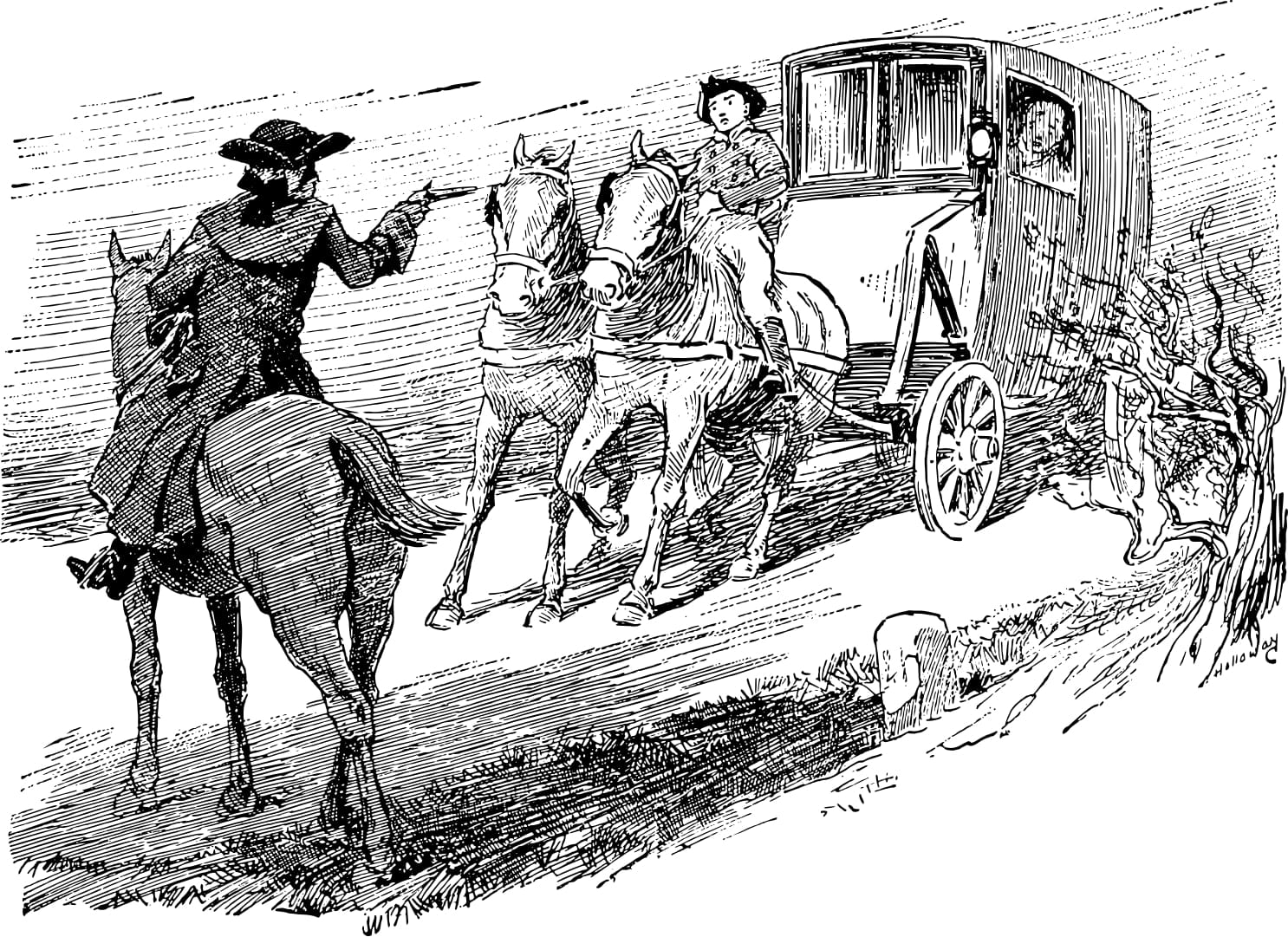
The romance genre is one replete with many types of characters and stories. There are swashbuckling adventures with pirates and lost gold. There are also frontiersman on the search for vengeance and honor. In this “The Highwayman” by Alfred Noyes analysis, we will see how the author conveys a narrative through both action and romance.
What is the Romance genre?
To start, the romance genre is filled with a myriad of conventions, from it’s “treatment of chivalry” to its focus on love. However, it also features distinct moments of adventure. Examples of this could be from The Last of the Mohicans by Daniel Dafoe or The Three Musketeers by Alexandre Dumas. Both of these novels feature characters haranguing about love while out on desperate adventures of danger and violence.
Summary of “The Highwayman” by Alfred Noyes
The poem by Noyes is a narrative verse set in the 18th century. It tells the story of a highwayman who is in love with the landlord’s daughter, Bess. The flamboyant highwayman leads a double life of robbery and love. The tale is a tragedy, as Bess sacrifices herself to warn the highwayman of a trap set by the authorities. The poem focuses on themes of love, chivalry, and adventure. There is also a focus on a folkloric conventions. That is to say, it is said that the highwayman continued riding to the old inn-door even after his untimely death.
An Analysis of “The Highwayman,” Fitting these Conventions
The poem “The Highwayman” by Noyes is a captivating piece that artfully fits within the conventions of the romance genre. The narrative is set under moonlit moors and an old inn. This creates romantic, almost Tall Tale-esque backdrop. The elements of the poem, from the wind as a “torrent of darkness” to the moon as a “ghostly galleon,” set a mysterious. The darkness is all around us, the reader, as we follow The Highwayman on his nightly pursuits.
Noyes writes: “The road was a ribbon of moonlight over the purple moor, / And the highwayman came riding– / … / The highwayman came riding, up to the old inn-door.” This scene sets up a romantic setting while also emphasizing adventure, danger, and a chivalrous hero.
In other words, the protagonist–the highwayman–epitomizes the romantic hero with his bold and dashing presence. Clad in a French cocked-hat, claret velvet coat, and riding a fantastic horse, he embodies the archetype of a charismatic and adventurous hero. The vivid descriptions of his attire and the moonlit landscape contribute to the romantic aesthetic, drawing readers into a world of passion and danger.
The central love story between the highwayman and Bess, the landlord’s daughter, adds emotional depth to the poem. Their secret rendezvous and forbidden love are classic themes. They are also a hallmark of romance literature. “One kiss, my bonny sweetheart, I’m after a prize to-night,” says the highwayman. “But I shall be back with the yellow gold before the morning light;” Bess further dramatizes the story as she sacrifices herself to save her beloved highwayman. Her devotion and the tragic turn of events amplify the emotional impact. This aligns itself with the romance genre.
Additionally, the poem fits into two parts. As such, the structure makes it more narrative in nature. As such, the structure of the poem exemplifies a story-driven excursion into storytelling, even through poetry. This narrative feel is very much in line with other romantic genre pieces, such as Dafoe’s The Last of the Mohicans and Dumas’s The Three Musketeers.
Conclusion
By looking at this Alfred Noyes “The Highwayman” analysis, we can understand a few things. One, is that the author masterfully incorporates the conventions of the romance genre through setting, characters, love, and tragic outcomes. Two, we can see that the author creates an exciting plot and creates exciting plot through the execution of genre writing. By definition, the author weaves a tale that that both engages readers and forges an interesting, romantic tale.
Works Cited
Noyes, Alfred. “The Highwayman.” Collected Poems. 1947.
Leave a Reply